The Collapse of Agency
Recognizing the symptoms of cognitive dissolution
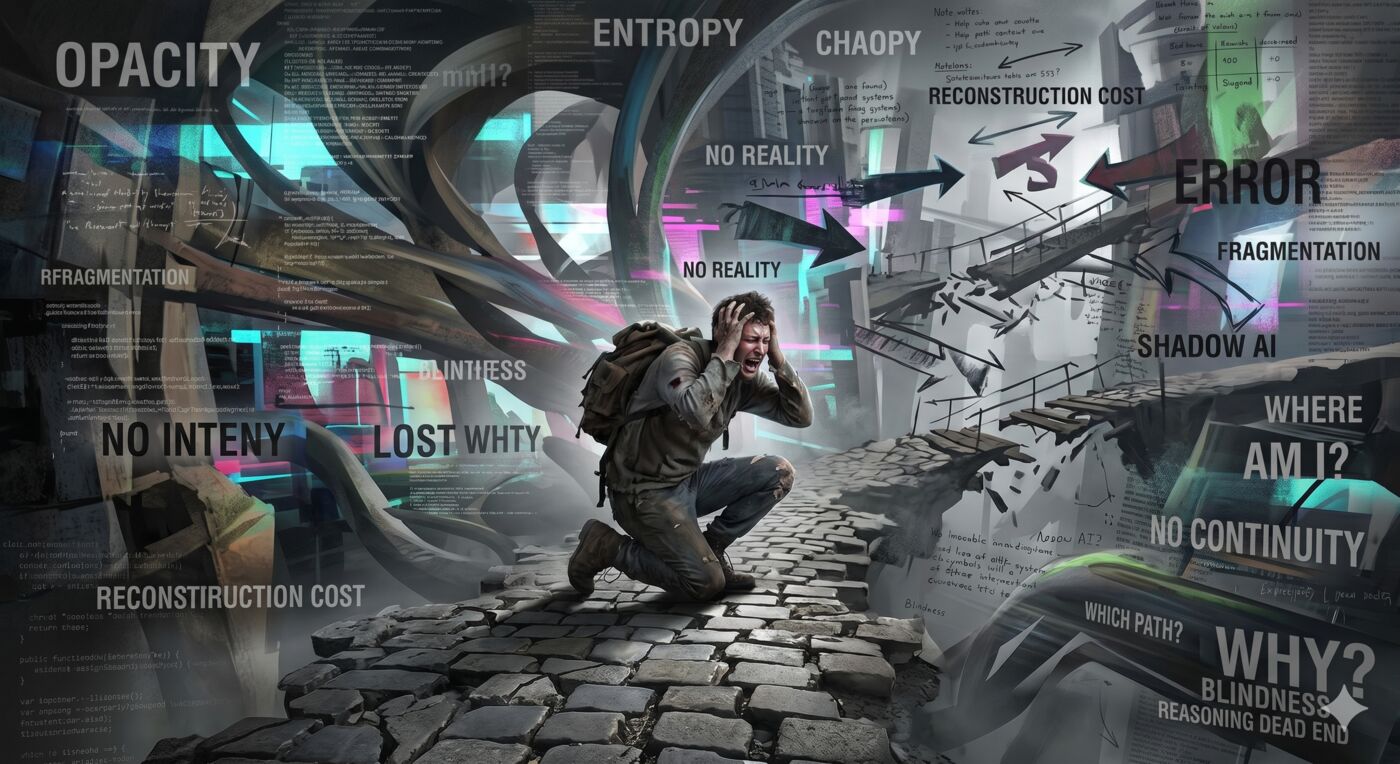
The current narrative around AI adoption is an optimistic one: unparalleled efficiency, the democratization of expertise, an end to routine drudgery. This essay argues that the framing obscures something more troubling. The productivity gains widely celebrated are often purchased at the cost of a single, critical property of professional work: unified human agency. What looks like optimization is, in a meaningful number of cases, a structural collapse of the agent — a discontinuity between a person's own reasoning and the actions eventually taken in their name.
The Illusion of Augmentation
To understand this collapse, it helps to be precise about the relationship between a worker and their tools. The model of augmentation assumes the human agent remains the origin of intent and reasoning, with the tool simply extending their reach — carrying a person's own reasoning trace through to its conclusion. Under this model, the connection between thought and action stays unbroken, and the tool is essentially transparent.
That is the assumption most current AI adoption narratives rest on. It does not match how these tools are actually used in practice.
The Mechanism of Fragmentation
The current toolscape is not a transparent extension of a person's own reasoning; it is frequently a source of fragmentation. What this site calls Shadow AI — AI use that leaves no trace of the reasoning behind its output — is not a hypothetical risk. It is already a routine source of friction.
When a person uses AI to produce an answer without any embedded record of their own reasoning, a disconnection is created between their intent and the system's output. The system delivers a result. It does not carry forward the thinking that was supposed to have produced it.
The Cost of Reconstruction
This disconnection creates a real, largely invisible cost: reconstruction cost. When an output lacks any embedded trace of the reasoning that produced it — what this site calls a reasoning vehicle — the person receiving it has to reconstruct that reasoning themselves before they can actually use, trust, or extend it.
Every opaque summary, every unexplained AI suggestion, requires the reader to reverse-engineer why the system produced that particular result. This repeated, low-visibility reconstruction work is a genuine cost, not a minor inconvenience — an invisible opportunity cost that quietly converts theoretical efficiency gains into real friction.
From Access to Meaning
The promise of the Information Superhighway was more access — more connection, more information, an assumption that connecting the world would accumulate into wisdom. It didn't, on its own. Information volume outpaced anyone's capacity to make sense of it, and AI was in part built to help manage that overload.
But volume was never the actual bottleneck. Information is not the same thing as meaning, and meaning depends on continuity of reasoning — something the current infrastructure was never built to preserve. The more useful question isn't how to move information faster, but how to build systems that retain the reasoning behind it: a Cognitive Super Highway, built for the durability of understanding rather than the speed of data.
Without continuity of reasoning, we retain the outputs of our thinking but lose the ability to stand behind them.
— Arne MayohDeclaration of Generative AI and AI-Assisted Technologies
This essay was developed with the assistance of AI systems as a research and editorial tool, for drafting support and structural revision. The argument and conclusions are the author's own.