🟢 Persistent Semantic Scaffold (PSS)
A Persistent Semantic Scaffold is a structured, durable semantic substrate that preserves reasoning, stabilizes meaning, and enables understanding to be continued across time.
Use this when
Use this concept when reasoning must persist beyond individuals, sessions, or systems — and when meaning must remain stable enough to be inspected, extended, and governed.
Where you experience this
- when complex systems evolve over time without losing interpretability
- when reasoning can be revisited and extended without reconstruction
- when decisions remain traceable to their original justification
- when shared understanding survives across participants and time
Opposing Force
Without a scaffold, systems drift toward Interpretive Entropy, where meaning diverges from original intent and becomes increasingly difficult to reconstruct.
System Role
Within PKOS, the Persistent Semantic Scaffold is the foundational infrastructure layer that enables continuity. It holds concepts, relations, and reasoning artifacts in a form that allows inspectable accumulation and governed evolution.
What It Is
A Persistent Semantic Scaffold is not a database, document system, or knowledge graph in isolation. It is a structured environment in which meaning itself is stabilized, so that reasoning can persist without fragmentation.
It anchors definitions, preserves relationships between concepts, and maintains the lineage of reasoning over time. Rather than storing outputs alone, it retains the semantic structure that allows those outputs to be understood and continued.
Why It Matters
As systems grow in complexity and duration, the ability to reconstruct prior reasoning becomes increasingly difficult. Without a scaffold, this leads to rising Reconstruction Cost, semantic drift, and eventual breakdown of shared understanding.
A Persistent Semantic Scaffold reduces this burden by externalizing reasoning structure. It allows systems to evolve without losing interpretability, replacing cycles of fragmentation and rewrite with continuity and repair.
How It Works
- anchors concepts as stable semantic units
- preserves relationships between concepts across time
- maintains reasoning lineage through structured artifacts (e.g. PIFRs)
- enables controlled mutation through governance boundaries
- supports accumulation without loss of inspectability
Relation to PKOS
The Persistent Semantic Scaffold is the underlying structure that enables PKOS to function. It supports continuity, enables reasoning networks, and provides the conditions for inspectable accumulation. Other mechanisms — such as Structural Retention and Responsibility Boundaries — operate within this scaffold.
Continuity Implication
Continuity depends on the existence of a scaffold. Without it, reasoning cannot be reliably carried forward. With it, understanding becomes durable and extendable, allowing systems to accumulate meaning rather than repeatedly reconstruct it.
Research Context
This concept is developed further in the working paper: Persistent Semantic Scaffolds (PSS), which explores interpretive stability, mutation governance, and long-horizon human–AI systems.
Illustration
The diagram below illustrates how reasoning flows across domains within a scaffold. Arrows represent reasoning trajectories (PIFRs), while domains represent semantic regions held together by the underlying structure.
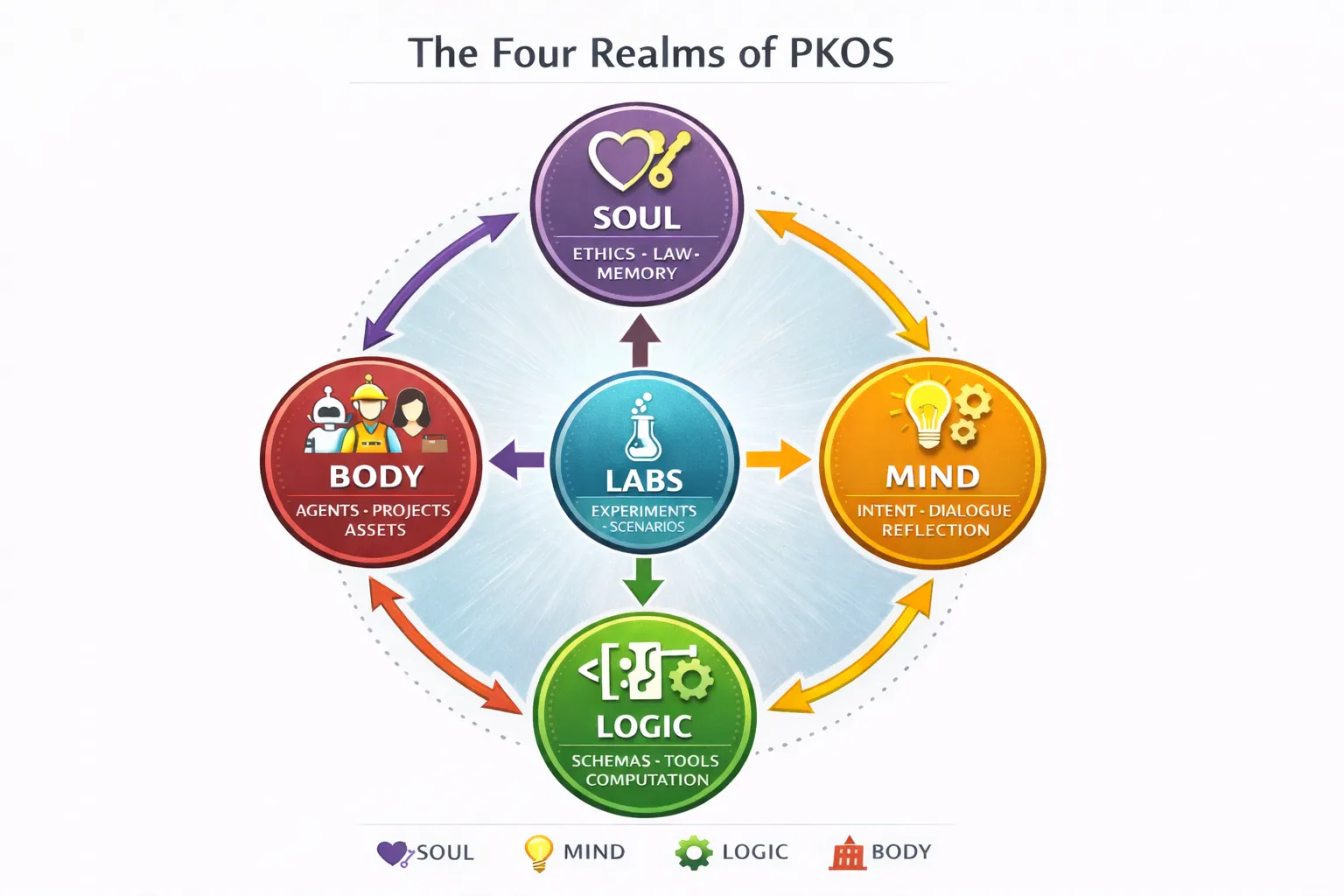
If Continuity names the Coherence half as a condition, Persistent Semantic Scaffold is what makes that condition physically possible — the actual substrate holding the sustained relation together, not just the fact that it holds.
Connected Concepts
In Tension With
A scaffold does not produce understanding — it makes understanding survivable.
← Back to Lexicon