
Concept Map
Where each part of this site lives, and which one is yours to start with
This isn't a map of every idea inside PKOS — that map already exists, and it's called Architecture. This is a map of the site itself: seven destinations, each doing a different job, so you can find the one that's actually yours before going any deeper.
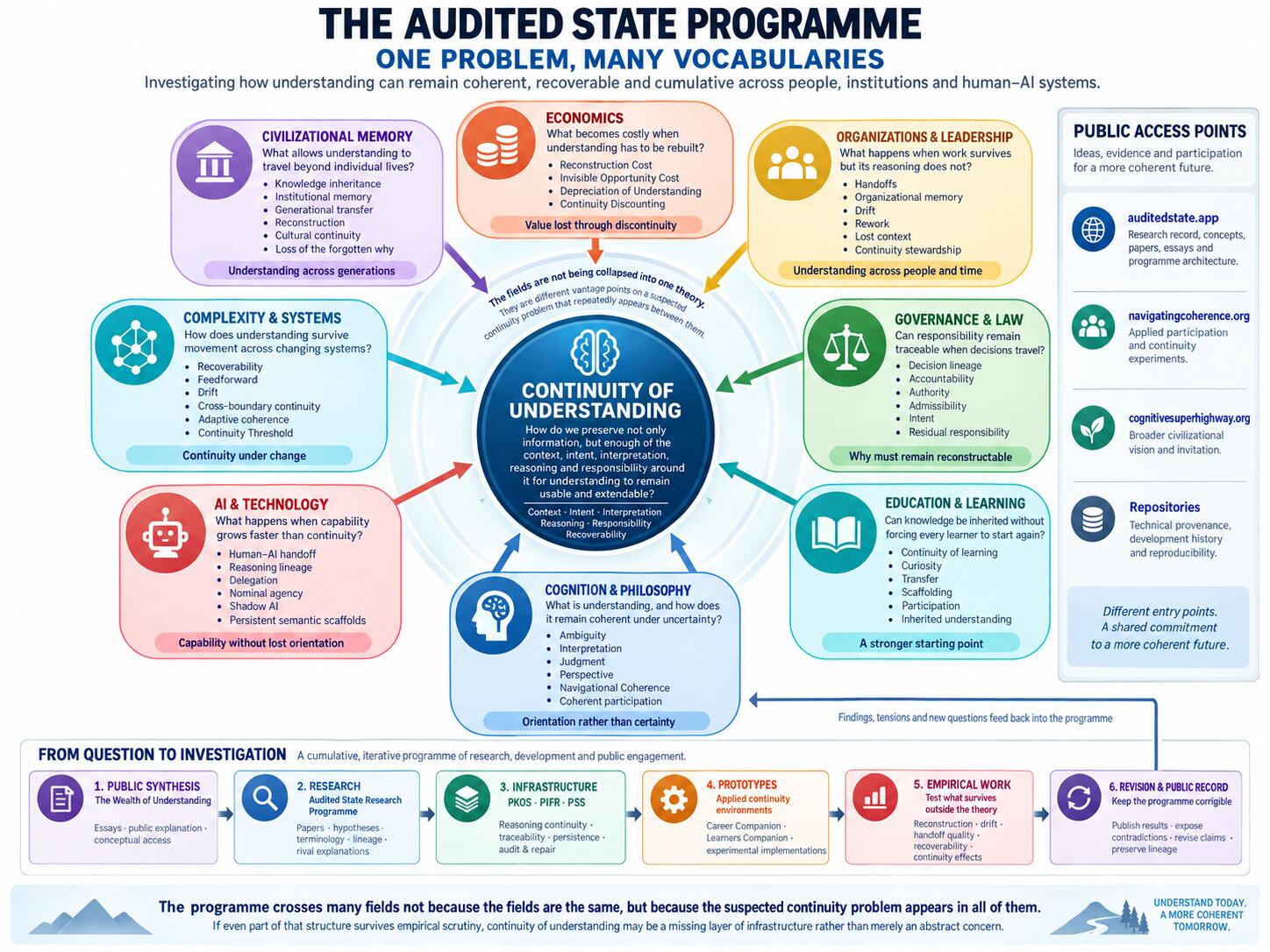
Wherever you came from — economics, governance, education, AI, systems theory — this is the shape of what connects it to everything else here. One question underneath many vocabularies: how can understanding remain coherent, recoverable, and capable of being carried forward?
The Shape of It
Start with Problem if you want to know what's actually at stake, plainly stated. Move to Architecture once you want the mechanism — how it actually works, in three perspectives depending on what you're bringing to it. Visit Philosophy if the words themselves need a foothold first, or if you want the felt version of an idea rather than the functional one. Labs shows the mechanism in practice — the actual loop a piece of reasoning moves through. Research holds the formal papers and citations behind all of it. The Lexicon is where you go once you already know what you're looking for and just need the precise definition.
| If you want… | Go to |
|---|---|
| What's actually at stake, stated plainly | Problem |
| How it works — signalling, safety, what's carried | Architecture |
| A foothold for an idea before the precise words make sense | Philosophy |
| The mechanism in practice, one step at a time | Labs |
| The formal papers and citations | Research |
| A precise definition, once you know the term | Lexicon |
| Who's behind this, and why | About |
If You Already Know Some of the Vocabulary
A few terms come up everywhere on this site and are worth knowing before you go further: PIFR is the carrier of a piece of reasoning. Promotion Gate is the checkpoint reasoning passes through to become durable. Audit & Repair is what keeps the whole thing honest over time. Everything else builds outward from those three.
That's the whole map. Pick a door.