The Continuity of Learning
Why wisdom now compounds instead of resetting
The greatest tax on human progress isn't a shortage of data. It's the reconstruction cost of forgotten intent — the amount of a life spent relearning things once already understood, because the why behind the what was never actually captured.
Beyond the Linear Model
In the older model, learning was a dead end: a thought gets processed, a conclusion is reached, and the reasoning behind it is discarded. What this research programme argues instead is that learning behaves more like an ecology than a straight line — not simply movement from one point to the next, but a set of loops where today's effort actually strengthens tomorrow's starting position.
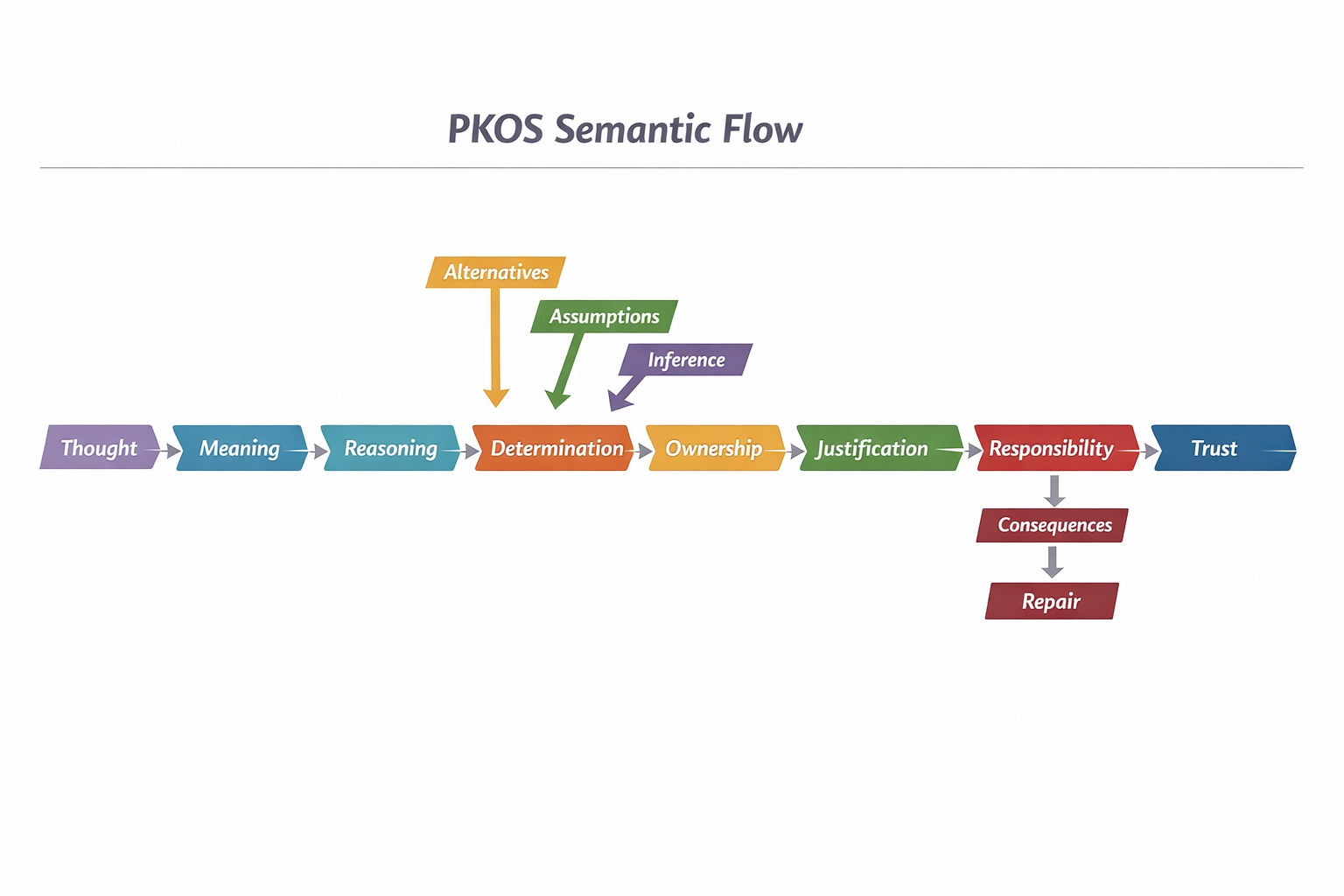
Two Kinds of Growth
As the diagram shows, trust is really the output of a cycle that can be repeated reliably. Making alternatives and justification explicit — rather than leaving them implicit — enables two distinct kinds of growth:
- Understanding, within a cycle: the ability to adjust course in real time, while still in the middle of working something out.
- Learning, across cycles: promoting a Reasoning Artifact into a Persistent Semantic Scaffold, so the system's memory becomes something the next person can actually build on.
Compounding, Not Resetting
Applying this consistently means no longer running in place. Work shifts from an uncoordinated tangle of disconnected efforts toward something where every decision becomes a data point for future growth, rather than something to quietly bury and move past.
That's the practical outcome this whole backbone narrative has been building toward: a way of working — for people and AI systems together — in which human understanding actually compounds, instead of resetting every time a session ends.
Wisdom doesn't require more memory. It requires memory that can be built on.
— Arne MayohDeclaration of Generative AI and AI-Assisted Technologies
This essay was developed with the assistance of AI systems as a research and editorial tool, for drafting support and structural revision. The argument and conclusions are the author's own.