Architecture
If the problem is loss of continuity of understanding, the solution must be infrastructure.
The architecture described here is not centered on outputs, but on preserving reasoning, meaning, and responsibility across time.
From: Problem · See: Infrastructure
Layer 1 — What Must Be Built
A system where understanding can:
- persist across time
- move across participants
- remain connected to its reasoning
Without this, systems rely on reconstruction instead of continuity.
Layer 2 — Structure and Flow
All reasoning systems operate through:
- Flow — how reasoning progresses
- Structure — how meaning persists
Flow enables progress. Structure enables stability.
See: Structure and Flow
Layer 3 — The Reasoning Loop
Reasoning operates as a continuous loop:
This loop transforms pressure into learning. Each cycle extends reasoning rather than restarting it.
See: Concept Map
Layer 4 — Structural Persistence
For reasoning to persist, it must exist within a stable structure.
This is achieved through the Persistent Semantic Scaffold (PSS) .
The scaffold is not a step in the process. It is the substrate that stores:
- reasoning artifacts
- system state
- audit history
Without this structure, continuity cannot exist.
Layer 5 — Reasoning as Signal
Reasoning must not only be stored — it must be carried forward.
The Reasoning Vehicle
Reasoning does not move as raw information. It moves as structured units that preserve meaning across domains.
A reasoning vehicle is the minimal unit of reasoning that can cross domains while remaining coherent.
Each reasoning vehicle carries:
- Intent — what is being attempted
- Justification — why this step exists
- Criteria — under what conditions it is valid
- Ownership — who is responsible for it
As reasoning moves between domains (mind, logic, execution, ethics), its form changes — but these elements must persist.
This is what allows reasoning to cross domains without being reconstructed.
Each transition is mediated by a reasoning vehicle PIFR: a structured reasoning artifact that carries:
- intention
- justification
- references to prior reasoning
- Ownership
This enables reasoning to move across contexts without reconstruction.
See: Reasoning as Signal
Layer 6 — Architectural Layers
The system separates reasoning into layers:
- Exploration Layer — human–AI reasoning and conjecture
- Authority Membrane — where reasoning becomes accountable
- Commitment Layer — decisions that alter shared state
- Semantic Layer (PSS) — persistent storage of reasoning and lineage
- Audit Layer — review and repair across time
These layers separate exploration from commitment, while preserving continuity across both.
Layer 7 — From Output to Lineage
Traditional systems optimize outputs.
This architecture shifts focus to lineage:
- every decision retains its origin
- every state remains traceable
- every change can be audited
Without this, systems drift into interpretive entropy.
Architectural Outcome
The goal is Cumulative Reasoning :
a system where reasoning extends across time, rather than being repeatedly reconstructed.
This is the minimal condition for stable progress under acceleration.
From Model to Practice
Concepts define structure. Architecture defines possibility.
But systems only become real through practice.
Understanding does not emerge from description alone — it emerges through iteration:
- exploration
- application
- feedback
- refinement
The Role of Labs
Understanding does not emerge within a single domain. It emerges through movement across domains — and is stabilized through feedback.
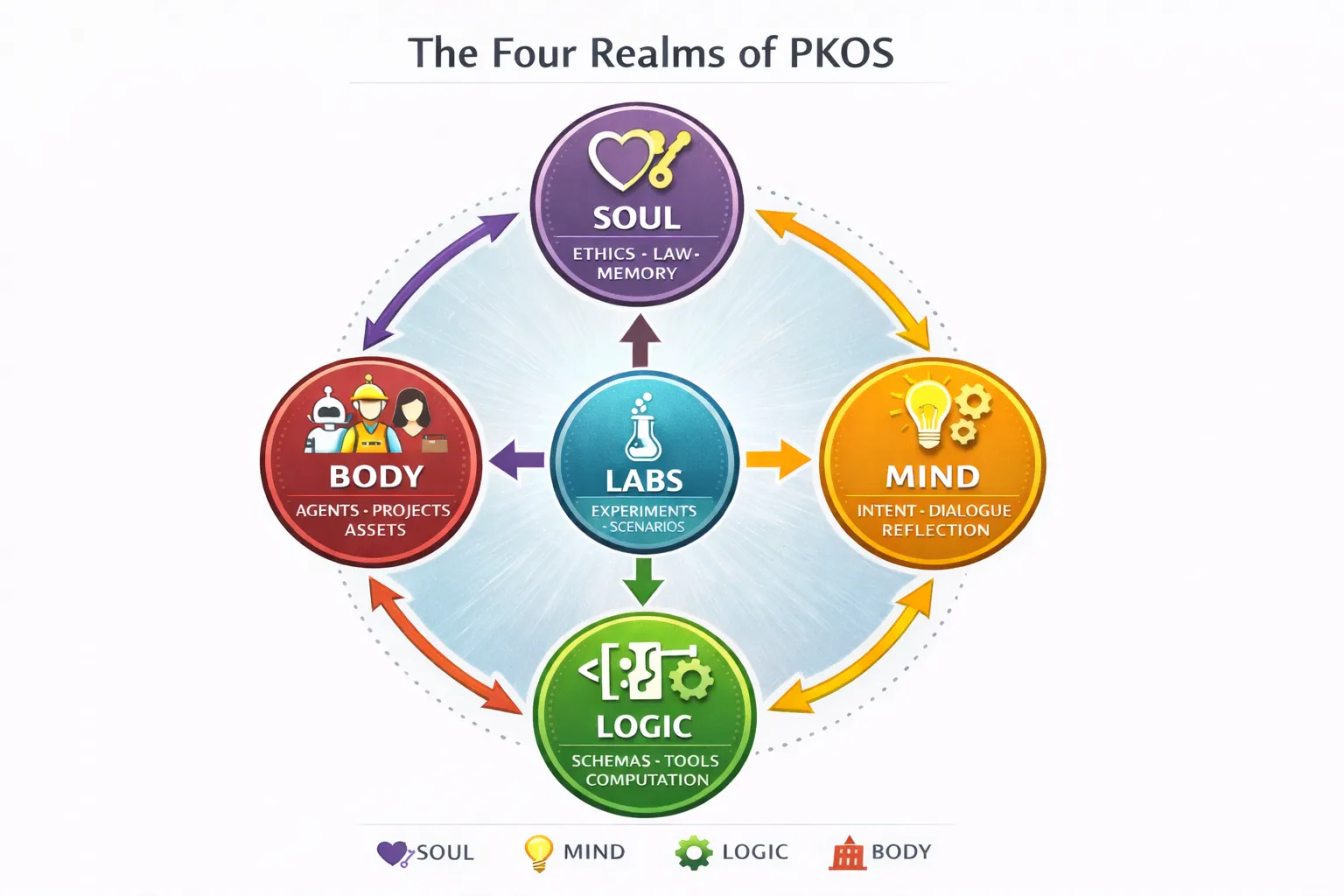
Each domain represents a different form of meaning:
- Mind — intention, dialogue, interpretation
- Logic — formal structure and computation
- Body — execution, agents, real-world impact
- Soul — ethics, law, memory, responsibility
Reasoning does not stay within one domain. It moves between them.
Each transition introduces transformation:
- intent becomes structure
- structure becomes action
- action creates consequences
- consequences reshape understanding
These transitions are carried by structured reasoning artifacts (PIFRs), which preserve intention and justification across domains.
At the center, Labs provide the environment where this flow is tested:
- scenarios are explored
- outcomes are observed
- reasoning is refined
Without this loop:
- structure cannot be validated
- flow cannot be stabilized
- continuity cannot emerge
This is why PKOS emerged — not as a fixed solution, but as a system capable of learning across domains.
Structure spans domains. Flow moves between them. Labs make the system learn.
See: Labs
Infrastructure does not dictate behavior. It enables understanding.
Understanding enables continuity. Continuity enables progress.