🟢 Continuity
Continuity is the ability for reasoning to persist across time without requiring reconstruction.
What It Is
Continuity is not the preservation of information. It is the preservation of reasoning in a form that can be continued.
A system has continuity when understanding can move forward without needing to be rebuilt from fragments, reinterpreted from outputs, or inferred from incomplete traces.
Continuity exists only when reasoning remains:
- structured
- connected
- accessible for extension
What It Is Not
Continuity is often confused with memory, storage, or documentation. These are necessary but insufficient.
- Memory preserves information
- Storage preserves data
- Documentation preserves descriptions
None of these guarantee that reasoning can be continued.
Without continuity, systems rely on reconstruction — rebuilding understanding from partial or indirect evidence.
The Continuity Threshold
There exists a threshold where reconstruction becomes dominant.
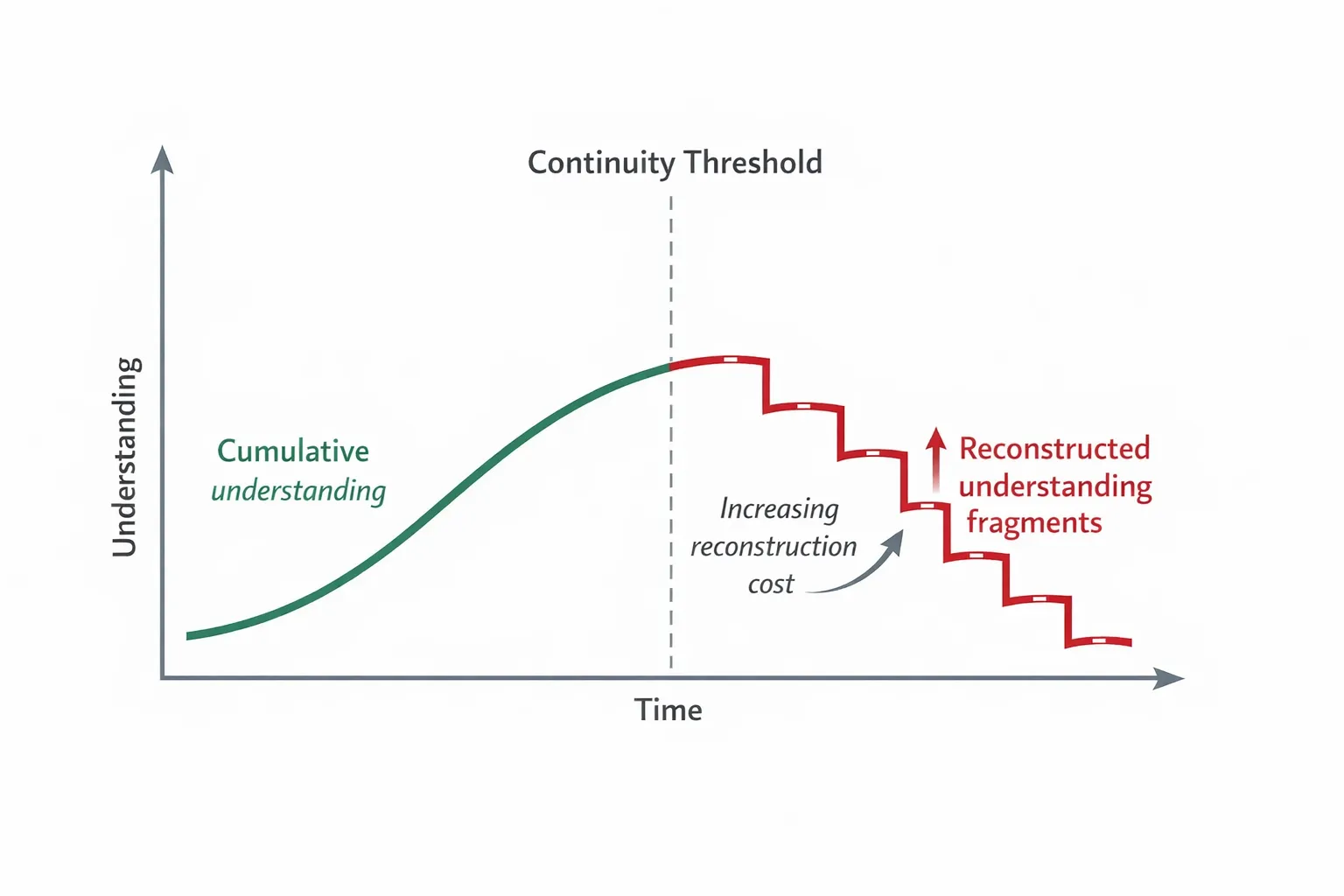
Below this threshold, systems operate through connected reasoning. Beyond it, they rely on reconstruction.
- understanding accumulates
- reasoning can be extended
- context remains stable
Above this threshold:
- understanding fragments
- reasoning must be rebuilt
- context decays
This transition is not gradual. It represents a shift from cumulative learning to cyclical reconstruction.
Why It Matters
Without continuity, learning does not accumulate. It repeats.
Systems may still produce outputs, generate insights, and appear productive — but the underlying understanding does not compound.
Over time, this leads to:
- increasing reconstruction cost
- semantic drift
- loss of decision lineage
- fragmentation of knowledge
This creates a system that produces more information while retaining less understanding.
How Continuity Is Achieved
Continuity is not automatic. It requires structural conditions:
- Persistent Semantic Scaffold — stabilizes meaning
- Structural Retention — preserves reasoning
- Reasoning Network — connects reasoning
- Continuity Bridge — carries reasoning forward
Together, these form the minimum structure required for understanding to accumulate.
Relation to PKOS
PKOS exists to preserve continuity under conditions of accelerating reasoning.
It does not optimize for output, but for the ability of reasoning to remain:
- inspectable
- traceable
- continuable
Continuity is therefore not a feature of the system — it is its governing constraint.
Failure Condition
When continuity fails, systems enter a reconstructive state:
- Ephemeral Processing increases
- Fragmentation spreads
- Reconstruction Cost rises
- Interpretive Entropy accelerates
At this point, effort shifts from advancing understanding to maintaining coherence.
Continuity is the Coherence half, named directly rather than through a metaphor: the sustained persistence of reasoning that Navigational Coherence's whole practice depends on having something to navigate.
Continuity is the condition under which understanding becomes cumulative.