Drift, Drift... DRIFT!
The most dangerous loss of control is not when things break. It's when they continue — just no longer aligned with intention.
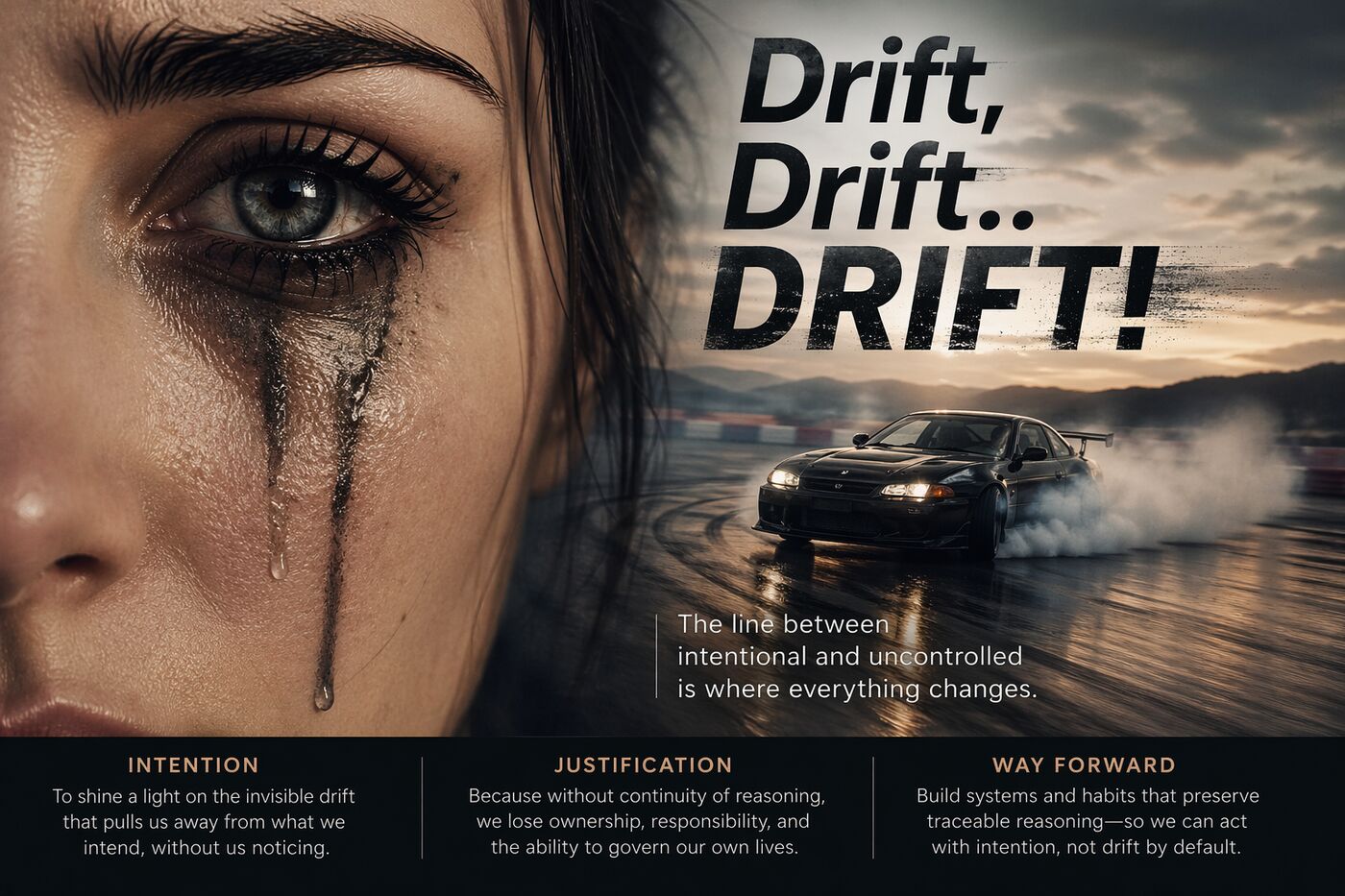
Intentional Drift
Intentional drift is not failure. A car enters a corner too fast, the rear loses grip, the vehicle slides sideways — and yet the driver holds the line. Drifting is often defined as losing traction while maintaining control, a contradiction that only works because something stays intact underneath it: continuous feedback, constant correction, awareness of direction. The driver knows they're drifting, and it's precisely that awareness that keeps them in control. That's why drift can be creative, exploratory, even beautiful — movement beyond strict alignment, without losing orientation.
When Drift Changes Character
Now remove one element: awareness. The movement continues, outputs continue, progress still looks intact. But there's no clear feedback, no correction, no stable reference point left. This is where drift changes — not into chaos, but into uncontrolled alignment loss.
Drift in Reasoning
This pattern doesn't stay metaphorical. It shows up directly in how reasoning actually moves through systems: a decision gets made, summarized, reused, translated, applied somewhere else. Each step seems valid. Each step produces real output. But something subtle disappears along the way — the reasoning path itself. Without that path, systems fall back on interpretation, approximation, reconstruction. This is where semantic drift begins, not through error, but through quiet replacement: reasoning replaced by interpretation.
The Invisible Transition
Because outputs stay coherent, this shift is genuinely hard to detect. Fluency hides drift. Consistency hides drift. Progress itself hides drift — until something finally breaks. By then, the origin is distant, the reasoning is fragmented, and reconstruction becomes necessary. Reconstruction is never neutral: it introduces assumptions, interpretive bias, structural deviation. This is where reconstruction cost actually begins.
From Accumulation to Reconstruction
At small scale, this stays manageable. At system scale, it compounds — work stops accumulating and becomes repeated reconstruction of something that already existed once. This marks a real shift toward the continuity threshold, beyond which understanding fragments faster than it can be restored, decisions lose their lineage, and alignment becomes genuinely unstable.
Drift and Human Agency
Acting with intention requires following your own reasoning, understanding how you arrived somewhere, and continuing from that point — the actual basis of human agency. When reasoning can no longer be carried forward, intent detaches from action, responsibility becomes diffuse, and ownership quietly weakens. The shift is gradual: from driver to passenger. Still present. Still producing. No longer fully directing.
Drift at System Scale
AI accelerates this same pattern. Systems now produce reasoning-like output at real scale, without guaranteed lineage, traceable state, or reasoning continuity. That creates a new condition: reasoning exists, but can't be followed. This is Shadow AI — not hidden in usage, but hidden in structure. Its reasoning can't be traced, can't be fully inspected, can't be reliably continued. And because everything still works on the surface, it spreads.
The Real Loss
Drift's primary cost was never time or efficiency. It's alignment between intention and outcome — and without that alignment, governance weakens, accountability dissolves, and agency erodes, quietly, one small step at a time.
We don't lose control all at once. We drift out of it. The difference between intentional movement and uncontrolled drift was never speed. It's whether we can still see how we got here — and whether we can continue from that point without starting over.
We do not lose control all at once. We drift out of it.
— Arne MayohDeclaration of Generative AI and AI-Assisted Technologies
This essay was developed with the assistance of AI systems as a research and editorial tool, for drafting support and structural revision. The argument and conclusions are the author's own.