🟢 Continuity Threshold
The Continuity Threshold describes the point at which systems can no longer maintain continuity of reasoning. The System Recovery Principle describes how systems either reconstruct or restore that continuity.
Formal Definitions
Continuity Threshold
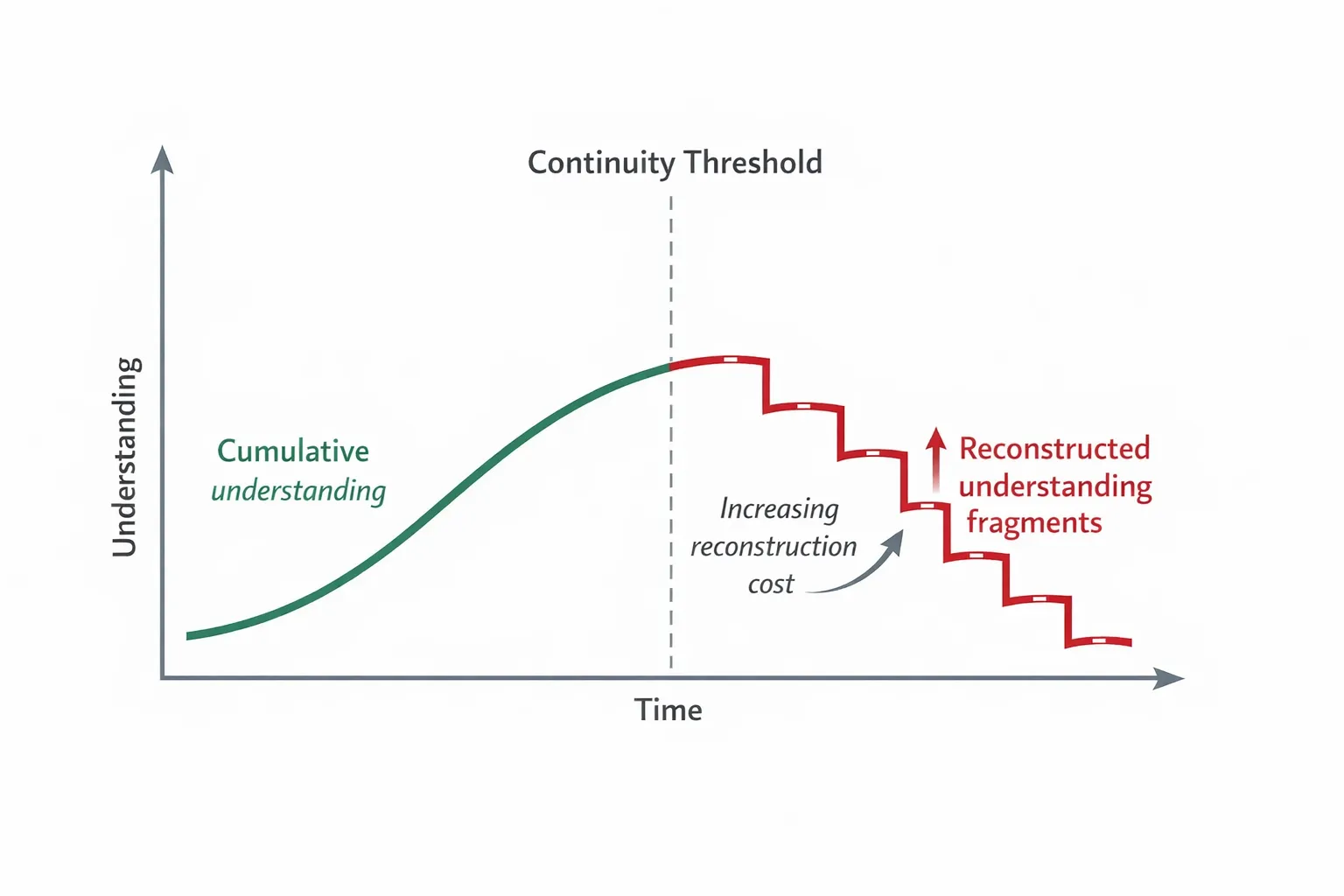
The Continuity Threshold is the point at which continuity of reasoning can no longer be maintained under the combined pressure of semantic growth, interpretive divergence, and reconstruction burden. Beyond this threshold, understanding no longer accumulates smoothly and must instead be repeatedly recovered from incomplete traces.
The threshold is not a single technical failure point. It is the condition under which continuity becomes too weak to support cumulative understanding without increasing dependence on reconstruction.
It is approached when semantic surface area expands faster than it can be stabilized, when interpretive entropy increases across time and contexts, and when reconstruction cost becomes a recurring burden rather than an occasional repair function.
System Recovery Principle
The System Recovery Principle describes what happens when continuity weakens or breaks. Systems either reconstruct reasoning at increasing cognitive, procedural, and institutional cost, or restore continuity through new structures that preserve reasoning trajectories as they develop.
Recovery can therefore take two forms:
- Reconstructive recovery — meaning and responsibility are recovered after the fact through effortful reconstruction.
- Continuity-preserving recovery — reasoning is carried forward in durable form, reducing the need for later reconstruction.
Mechanism
Loss of reasoning continuity → increase in reconstruction cost → reduced accumulation → system drift
When reasoning continuity is lost, systems increasingly depend on post hoc recovery. This raises the cost of reconstructing what was meant, why a decision was made, and how responsibility should be understood. As reconstruction becomes more frequent, understanding accumulates more slowly and in more fragmented form.
Under sustained pressure, systems begin to drift. Meaning diverges from original intent, responsibility becomes harder to anchor, and knowledge remains available without remaining fully usable.
Several concepts contribute to this condition:
- Interpretive Entropy describes the decay of shared understanding across time.
- Semantic Surface Area describes the expanding network of meanings and dependencies that must be held together.
- Reasoning Fragmentation describes the dispersion of reasoning across disconnected contexts.
- Shadow AI introduces untracked reasoning and decision influence without durable continuity.
- Reconstruction Cost describes the burden of recovering reasoning after continuity has already weakened.
Domain Mappings
| Domain | Below threshold | Beyond threshold |
|---|---|---|
| Courts | Reasoning remains reconstructable through preserved records and formal process. | Reconstruction becomes costly, slow, and institutionally burdensome. |
| Education | Learning accumulates through exposure to reasoning trajectories. | Outputs appear without reasoning traversal; learning becomes thinner and less cumulative. |
| AI usage | Decisions remain traceable and attributable. | Reasoning becomes opaque; responsibility diffuses across systems, actors, and interfaces. |
Relation to PKOS
PKOS is proposed as a continuity infrastructure designed to reduce dependence on post hoc reconstruction by preserving reasoning trajectories as they develop.
In this sense, PKOS is not introduced as a general solution to complexity, but as a recovery architecture for systems that would otherwise cross the continuity threshold and rely increasingly on costly reconstruction.
Continuity Threshold names the exact point where Coherence's erosion becomes qualitative, not just quantitative. System Recovery Principle, sharing this page, names the Navigational choice available once you're there: reconstruct at cost, or restore through structure that prevents the same crossing next time.
Related Concepts
Part of the PKOS Lexicon.