Reasoning Drift
When reasoning is not preserved, systems do not fail. They continue—while silently losing the ability to govern outcomes.
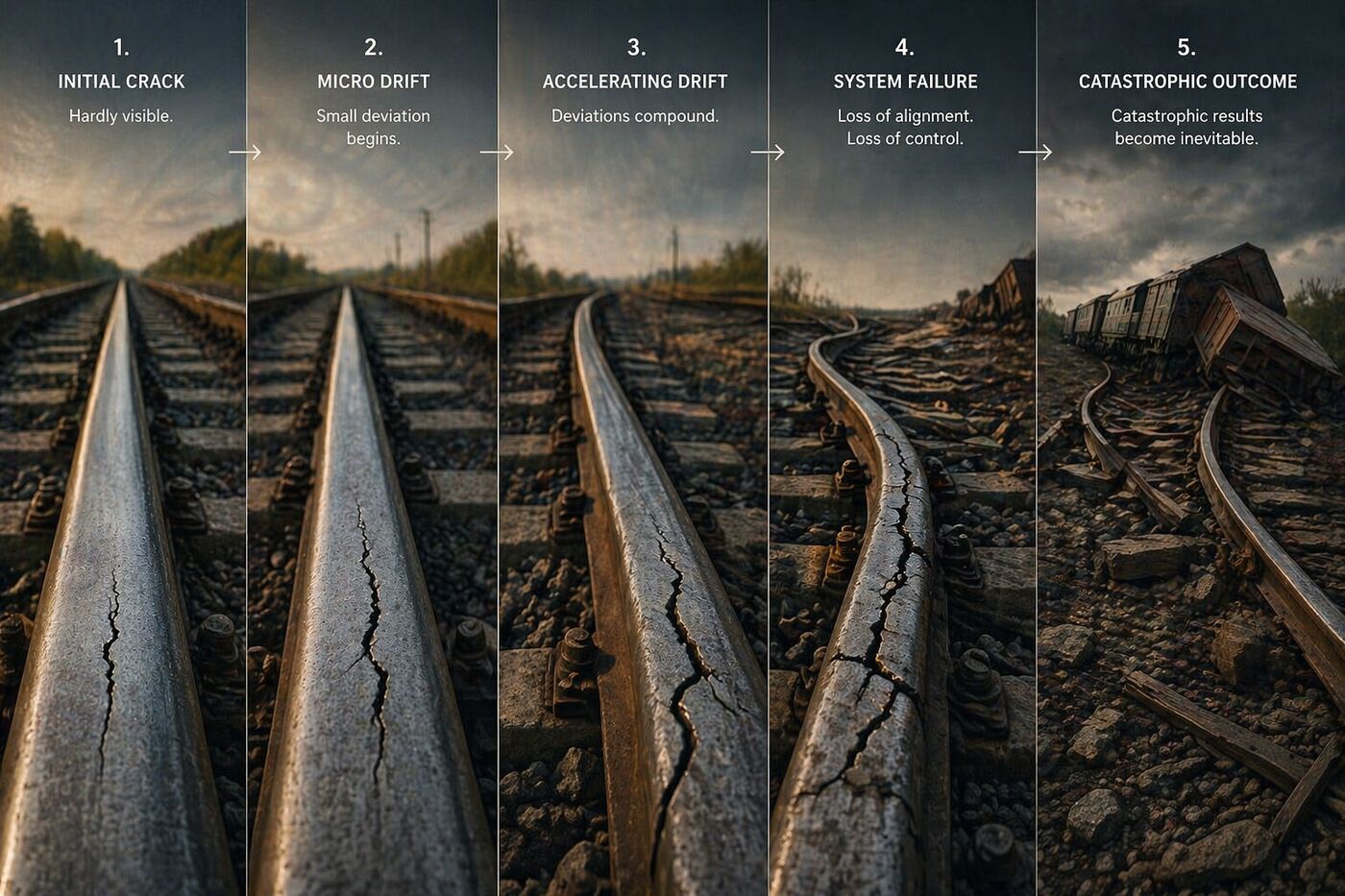
A system does not fail when the crack appears. It fails when the crack compounds unnoticed.
1. The Original Assumption
The Information Superhighway was built on a simple premise:
more access → more knowledge → better decisions
It externalized information.
But it did not preserve:
- reasoning
- assumptions
- decision lineage
So systems adapted through reconstruction.
At scale, reconstruction becomes drift.
2. Generative Systems Change the Equation
AI systems do not just retrieve or link information.
They produce reasoning-like outputs:
- fluent
- coherent
- convincing
But without guaranteed:
- lineage
- continuity
- inspectability
This creates a structural asymmetry:
output scales; reasoning does not
3. The Failure Mode: Reasoning Drift
Reasoning Drift is not error.
It is:
loss of alignment between output and originating reasoning
It emerges through normal operation:
- Reasoning is generated
- It is summarized
- Interpreted
- Reused
- Detached from origin
Each step is valid.
The system still works.
But alignment degrades.
4. Why It Is Systemic
Reasoning Drift is not a misuse problem.
It is a structural property of systems where:
- reasoning is not preserved
- outputs are reused across contexts
- interpretation substitutes continuity
Under these conditions:
- drift compounds
- fragmentation increases
- reconstruction cost grows
Until:
the system can no longer reliably connect decisions to their origin
5. Shadow AI: The Operating Condition
This produces what is now called:
Defined not by hidden usage— but by missing traceability.
It is the condition where:
- reasoning exists
- outputs are used
- but reasoning cannot be followed
This leads to:
- decisions without lineage
- outputs without grounding
- actions without full justification
6. Consequences
- Knowledge does not accumulate
- Systems cannot be governed
- Accountability dissolves
- Responsibility diffuses
- Human agency erodes
Not through failure.
Through drift.
7. The Missing Layer
The response to this problem has focused on:
- ethics frameworks
- model alignment
- policy constraints
These operate on outputs.
The failure occurs in:
the movement of reasoning
What is missing is not control of results— but governance of reasoning itself.
8. Execution Gates as Infrastructure
Execution Gates are not safeguards.
They are structural requirements.
They sit between:
- reasoning
- and action
And enforce:
- continuity
- alignment
- traceability
- responsibility
They answer:
- Can this be followed?
- Can this be justified?
- Can this be continued?
If not:
execution does not proceed
This is not friction.
It is the minimum condition for governable systems.
9. Final
Without preserved reasoning:
- systems produce outputs
- decisions are made
- actions are taken
But:
they cannot be governed
Because governance requires:
continuity between intention, reasoning, and outcome
When that breaks:
drift becomes the default operating mode.
"This essay defines Reasoning Drift as a systemic failure mode in AI-era systems, where outputs scale without preserved reasoning, and establishes execution gates as a necessary infrastructure for maintaining governable continuity." — Arne Mayoh & ChatGPT