Backbone Narrative — Essay 11 of 11
The Horizon of Reconstruction Bankruptcy
When systems spend more reconstructing understanding than creating value
Civilisation has always depended on its capacity to preserve reasoning across time — from the legal precedents of ancient Rome to the peer-review systems of modern science, progress is built on interpretive continuity: the ability for one generation to inherit the thinking of the previous one without having to re-derive it from scratch.
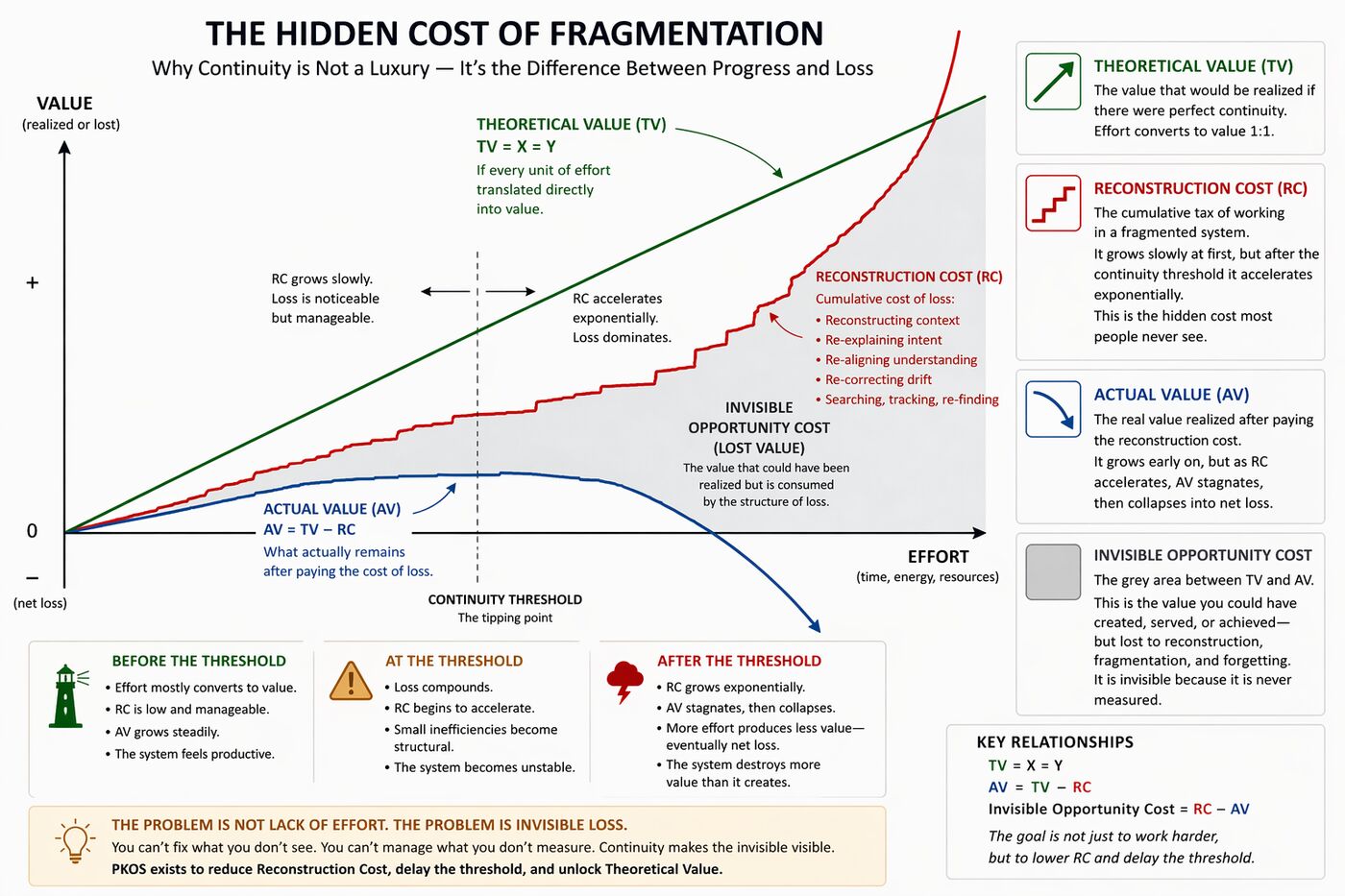
We are now approaching a structural tipping point. As AI accelerates the production of outputs without preserving the reasoning behind them, we're entering a condition worth naming directly: reconstruction bankruptcy — the point where the cost of reconstructing why a decision was made, what an output actually meant, and who was responsible for it exceeds the value the system produces in the first place.
The Invisible Labor of Recovery
Traditional economics measures throughput and efficiency, but it ignores the invisible labor required to re-establish shared understanding — reinterpreting prior decisions, rediscovering lost intent, resolving the semantic ambiguity that fragmentation leaves behind. Most organisations believe they're scaling intelligence. Often, they're really scaling the need for reconstruction — visible in the proliferation of meetings held just to understand prior meetings, and documentation that describes other, already-fragmented documentation. When reconstruction dominates creation, the system looks active. The understanding underneath it stops compounding.
AI and the Acceleration of Drift
AI systems intensify this by increasing the volume of decisions and delegations without automatically preserving continuity — a dangerous asymmetry, since AI accelerates output faster than any organisation can preserve meaning to match it. The result is operational expansion paired with epistemic fragmentation. In this environment, Shadow AI emerges not just as a security risk, but as a governance failure: decisions that look correct while carrying no reconstructable determination or accountability behind them.
The Governance Bottleneck
Governance — whether in courts or audits — is fundamentally a process of reconstruction: judges reconstruct intent, auditors reconstruct reasoning. But AI-mediated systems are now producing decisions at a volume that exceeds the total reconstruction capacity of human institutions. If the lineage of a determination can't be reconstructed, it can't be governed. What's left is a civilisation that functions on momentum while its foundational logic quietly becomes a black box.
Beyond Bankruptcy: The Continuity Economy
The next economic bottleneck isn't computation. It's continuity of understanding. Avoiding bankruptcy means moving from verifying ephemeral outputs to building Persistent Semantic Scaffolds — treating reasoning as a Traceable State rather than a transient signal, so a reasoning trajectory can move through time without the friction of reconstruction at every handoff. Structural alignment isn't only about safer AI. It's the continuity infrastructure required to prevent exactly this kind of civilisational insolvency.
Avoiding bankruptcy is only half the argument, and the less interesting half. The other half is what Paper 7 calls continuity capital — not the value recovered by preventing loss, but the exponential value created when understanding stays connected long enough to compound. A single piece of reasoning, promoted and preserved with fidelity, doesn't just sit there avoiding decay. Every time another mind builds on it rather than reconstructing it from scratch, that's a fresh round of the same multiplier effect that makes an economy grow from a single dollar of spending — except here, what's circulating is understanding, not currency. The real cost of reconstruction bankruptcy was never only the labor wasted. It was the compounding that never got to happen.
We thought AI would eliminate labor. It may first bankrupt us with reconstruction. The hidden cost was never computation. It was the reconstruction of meaning.
— Arne Mayoh
Declaration of Generative AI and AI-Assisted Technologies
This essay was developed with the assistance of AI systems as a research and editorial tool, for drafting support and structural revision. The argument and conclusions are the author's own.
This closes the eleven-part Backbone Narrative. Essays 9–11 (Civilisational Decay and the Invisible Opportunity Cost, Data as Representation of Truth, this piece) extend the original eight-essay arc into its full economic conclusion — and "Data as Representation of Truth" does double duty, serving simultaneously as essay 1 of the separate Interpretation, Drift & Cognitive Continuity series. The two series were always meant to connect at that point, not run as fully independent tracks.
Essay 11 of the Audited State Backbone Narrative.