Infrastructure for Understanding
We didn’t make traffic safe by teaching cars ethics — we made it safer by enabling participants to understand each other.
The Missing Layer
Much of the current discussion around AI focuses on behavior: better models, alignment, and governance.
But behavior alone does not create reliable systems.
What is missing is infrastructure — a shared environment where participants can understand each other¹, signal intention², and act predictably.
Semantic Flow — From Thought to Learning
Understanding is not a single step; it is a cycle that allows today’s effort to strengthen tomorrow’s start.
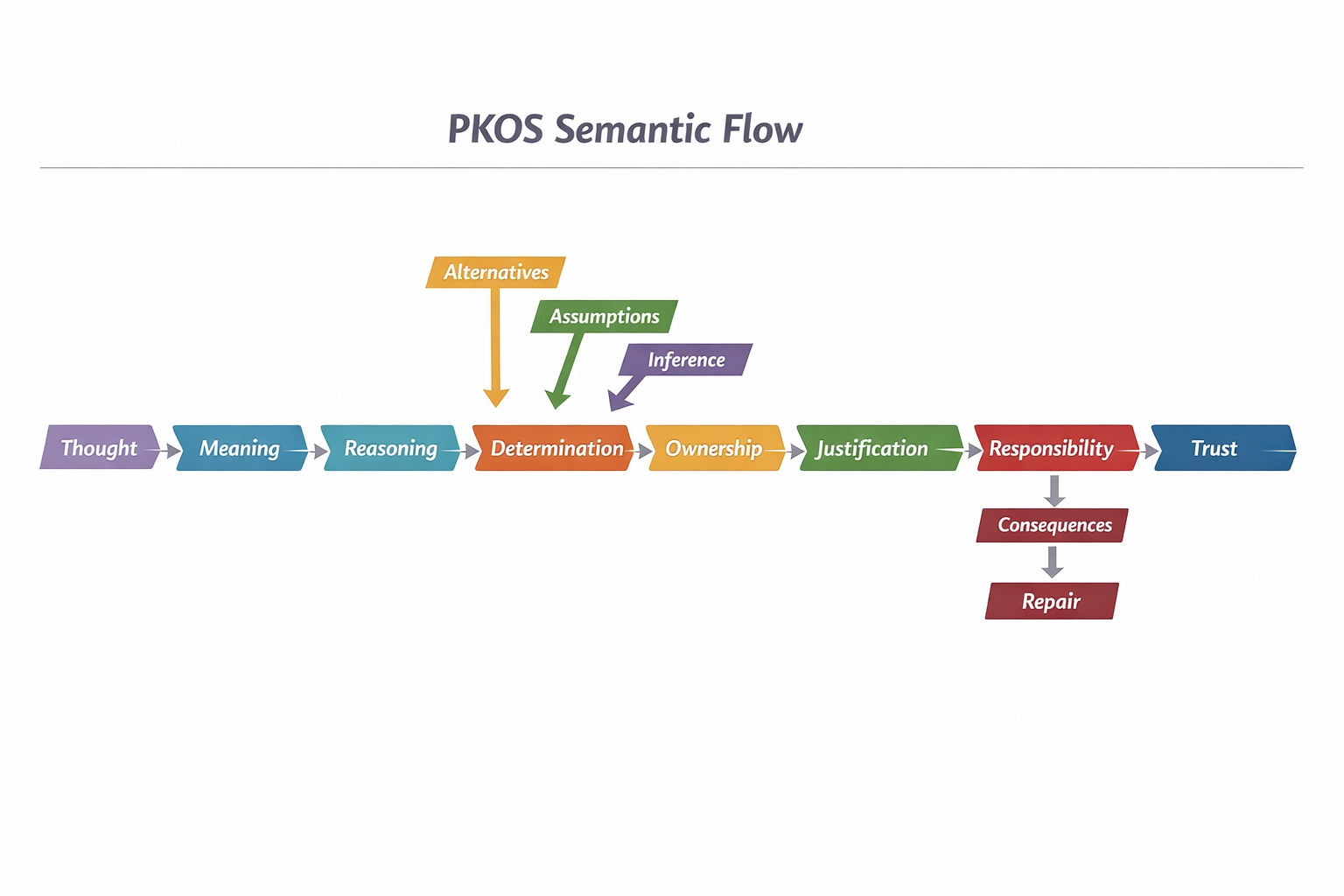
- Thought → Meaning → Reasoning → Determination
- Ownership → Justification → Responsibility → Trust
This flow represents how information becomes accountable action.
Learning Across Cycles
Understanding does not accumulate within a single reasoning process. It emerges across cycles through feedback.
In cybernetic systems, feedback loops allow systems to adjust behavior based on outcomes, enabling stability and adaptation over time.
- actions lead to consequences
- consequences require repair
- repair informs future reasoning
Without continuity, each cycle resets. With continuity, learning accumulates.
See: Continuity and Continuity Bridge
The Reasoning Vehicle
To persist across cycles, reasoning must be carried through the system.
In PKOS, this is achieved through a reasoning vehicle: a structured representation of intention, justification, and ownership.
Without such a vehicle, reasoning must be reconstructed — introducing ambiguity and drift.
See: Persistent Semantic Scaffold
Structure and Stability
All complex systems operate through a combination of flow and structure.
Flow enables movement. Structure enables continuity.
In PKOS, structure is represented by the Reasoning Network: a persistent topology of meaning that connects concepts, decisions, and dependencies.
- defines relationships
- preserves meaning
- enables reuse across contexts
Without structure, reasoning cannot persist. Meaning must be reconstructed, introducing drift and inconsistency.
See: Reasoning Network, Structural Retention
The Role of Continuity
Continuity is the condition that allows understanding to accumulate rather than fragment.
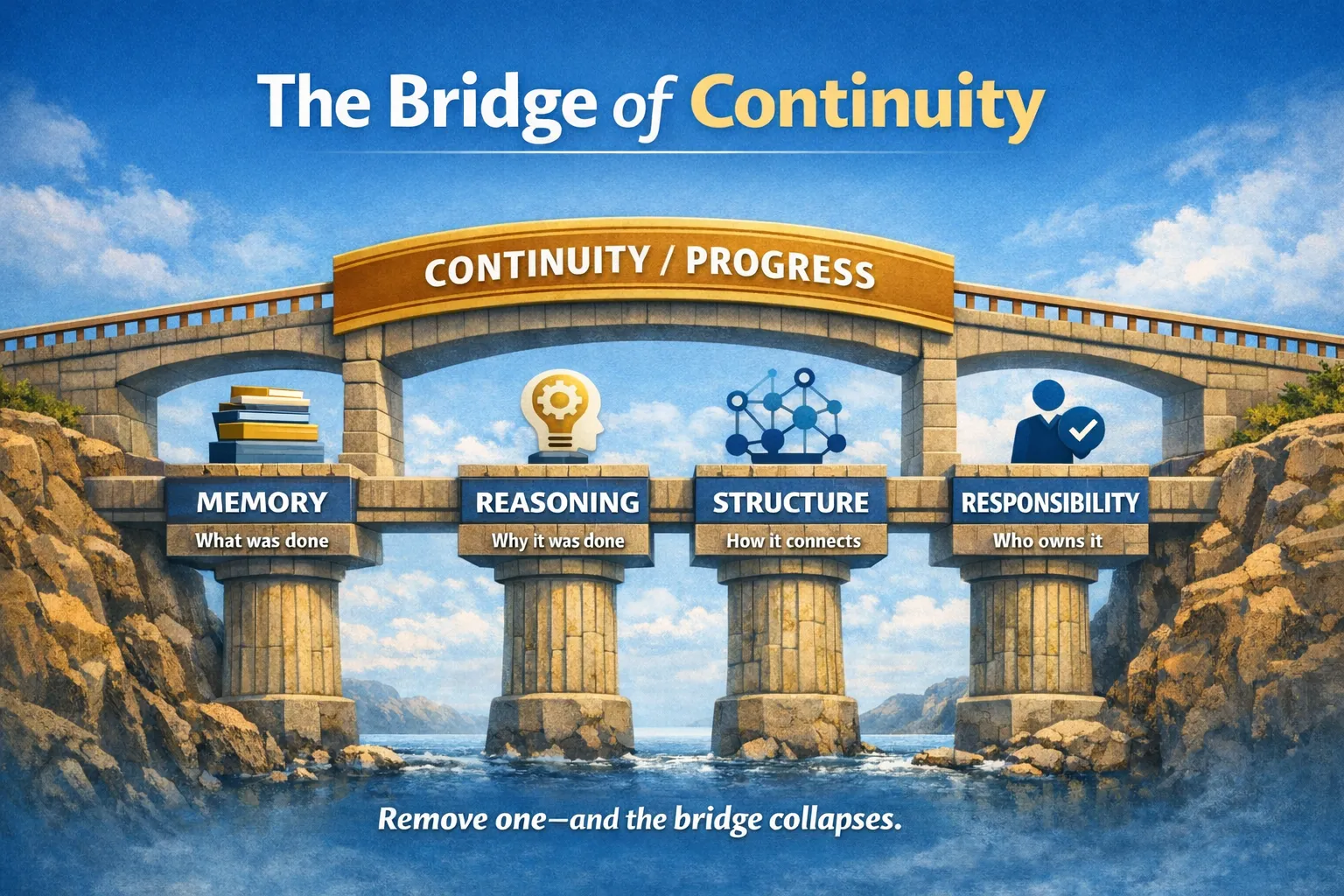
Continuity is not a single mechanism. It depends on a minimal structure:
- Memory — what was done
- Reasoning — why it was done
- Structure — how it connects
- Responsibility — who owns it
These correspond directly to the core concepts of PKOS:
Remove one — and continuity collapses.
Traffic as Infrastructure
Traffic systems work because participants can understand each other:
- signals communicate intention
- structure scales with consequence
- learning precedes participation
- laws assign responsibility
The same principle applies to AI systems.
Structural Bankruptcy
Modern systems are not failing due to lack of intelligence or effort. They are failing because the value generated by that effort does not persist. When reasoning is not preserved, every cycle introduces loss: context must be reconstructed, intent must be re-aligned, and understanding must be re-inferred. This loss is rarely measured, because it does not appear as failure—it appears as work. Over time, however, the system accumulates an invisible opportunity cost: value that could have been realized if effort had compounded, but instead dissipates through fragmentation.
This condition produces a structural gap between what systems could achieve and what they actually produce. In theory, effort should translate into value proportionally. In practice, systems pay a continuous tax of reconstruction that grows with complexity. As this burden increases, the system approaches a tipping point where more effort produces diminishing returns, and eventually negative outcomes. This is not a failure of participants—it is a failure of infrastructure. The system has crossed from accumulation into erosion.
When this condition becomes persistent, the system enters what can be described as structural bankruptcy: a state where the underlying mechanisms of understanding are no longer capable of preserving value across time. At this point, progress becomes illusory. Output continues, but understanding does not accumulate. Without infrastructure for continuity, even advanced systems remain trapped in cycles of reconstruction—expending increasing effort to maintain decreasing coherence.
The Missing Layer in AI
AI systems optimize reasoning flow.
But they lack persistent reasoning structure and continuity.
This leads to:
- reconstruction of meaning
- interpretive drift
- loss of continuity
Improving flow alone cannot stabilize the system. Stability depends on structure and continuity.
Flow enables progress. Structure enables stability. Continuity enables learning.
Understanding is not just knowing — it is the ability to continue.
The Hidden Cost of Fragmentation
The following model makes visible what is otherwise hidden in everyday systems: the relationship between effort, value, and loss when continuity is not preserved.
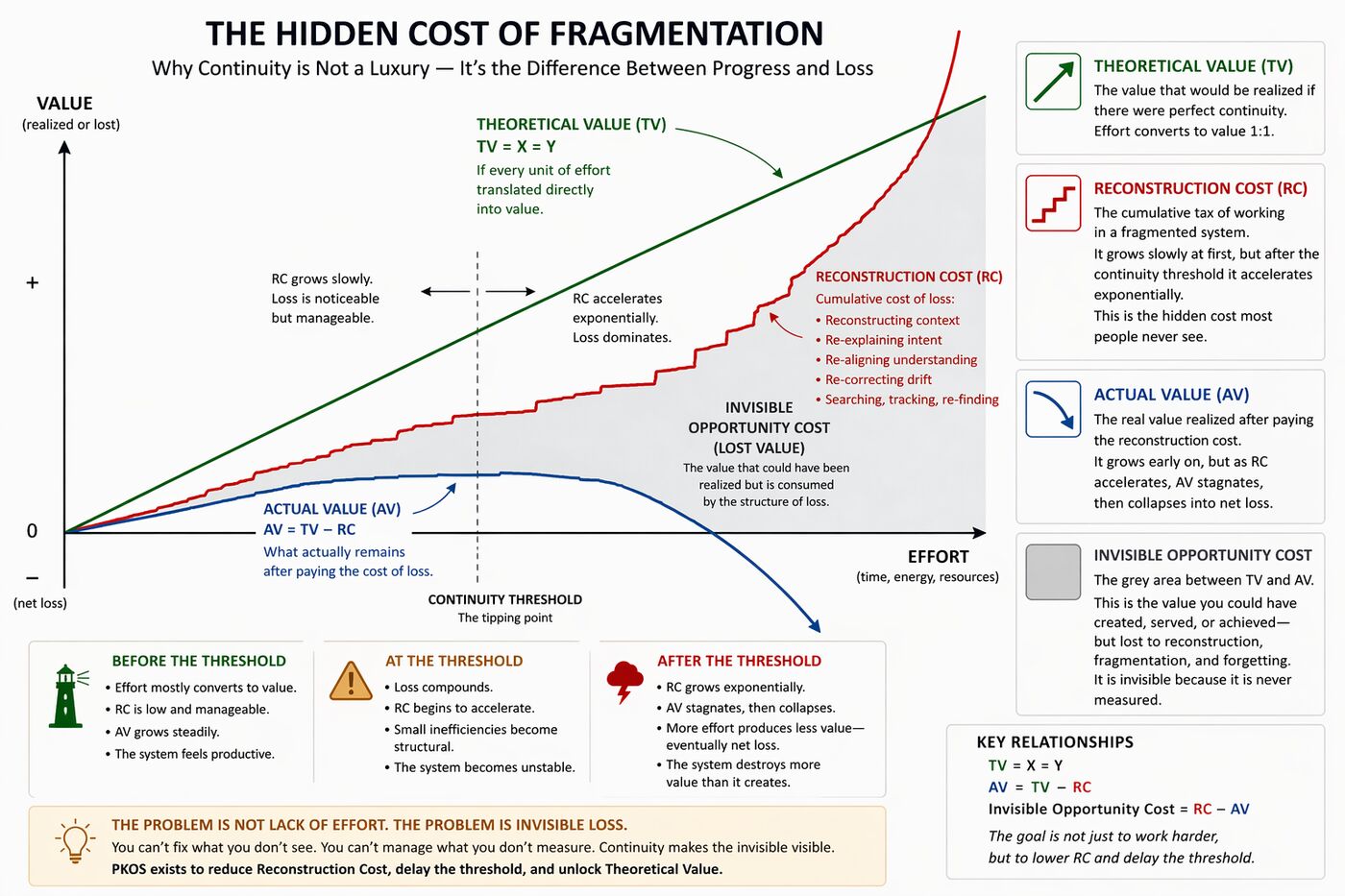
In systems without continuity, effort does not accumulate linearly. Instead, increasing portions of effort are consumed by reconstruction, until the system crosses a threshold where more effort produces less value.
This is not a failure of individuals or intelligence, but a structural property of systems lacking continuity and continuity bridges.