🧠 Structure and Flow
Understanding emerges from the interaction between structure and flow. Flow enables reasoning to move. Structure allows it to persist.
Use this when
Use this concept when reasoning must both progress and remain stable — when systems must support learning, coordination, and accumulation of understanding over time.
Where you experience this
- when reasoning progresses but remains connected
- when learning builds across cycles instead of resetting
- when meaning is preserved across time and participants
- when decisions remain traceable and reusable
Opposing Force
Without structure, flow becomes unstable and meaning must be reconstructed. Without flow, structure remains unused.
System Role
This concept connects the dynamic behavior of reasoning (flow) with the persistent structures that enable continuity within PKOS.
Semantic Flow — Movement of Reasoning
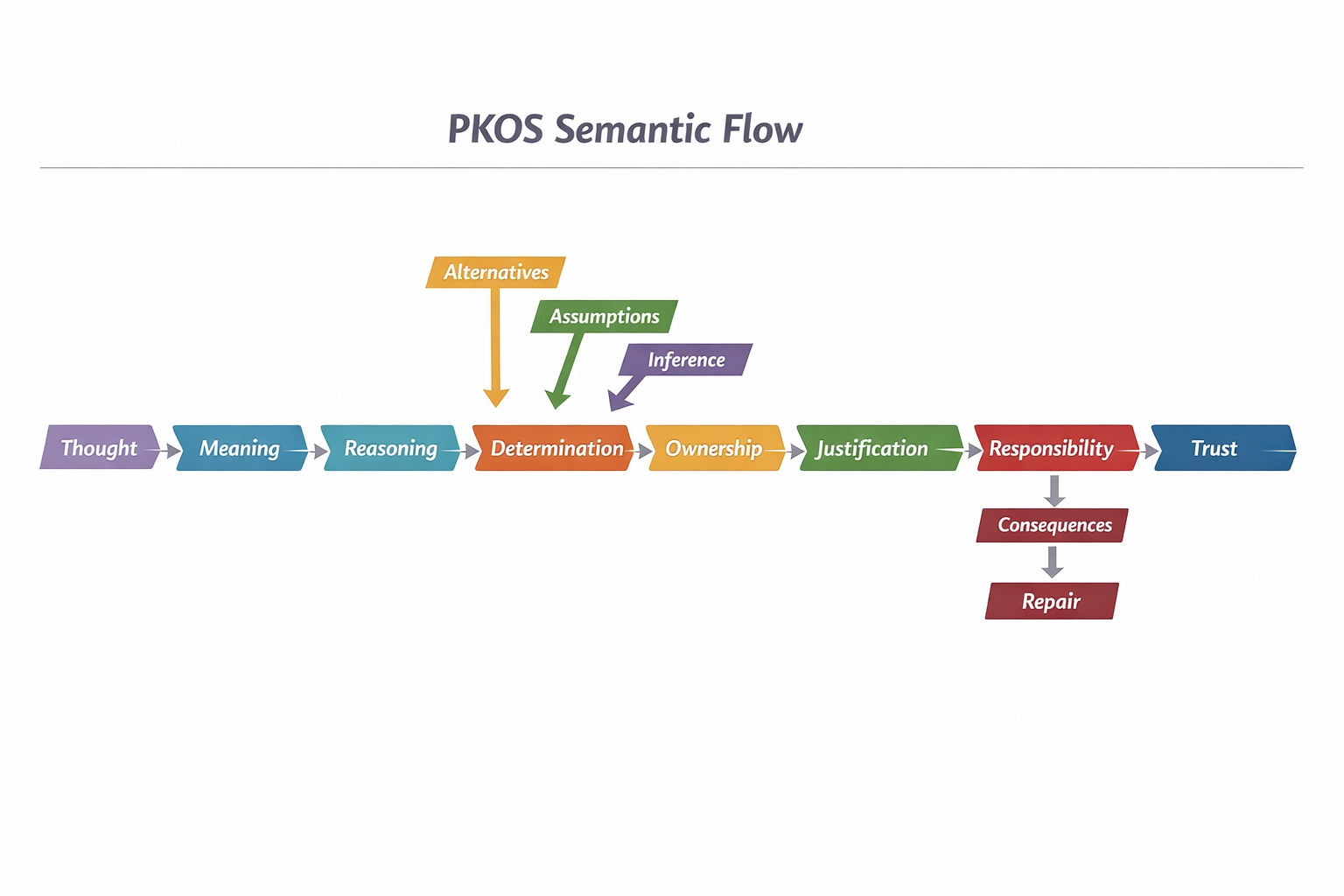
Semantic flow describes how reasoning progresses through stages:
- Thought → Meaning → Reasoning → Determination
- Ownership → Justification → Responsibility → Trust
This flow converts information into accountable action. It includes feedback loops that enable learning across cycles.
Without persistent structure, this flow collapses into inference and reconstruction.
Bridge of Continuity — Structure of Persistence
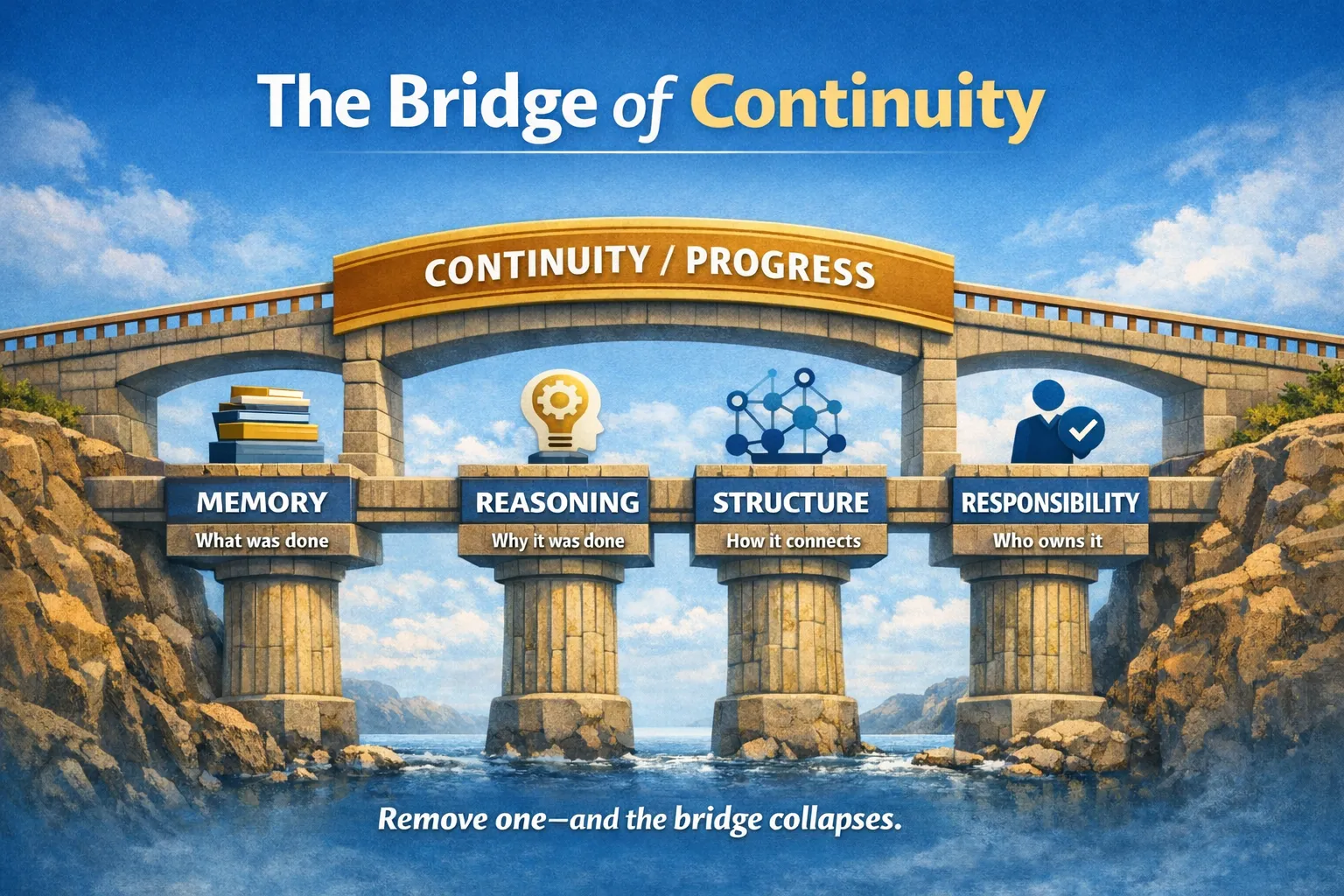
Continuity is not created by flow alone. It depends on a minimal structure that allows reasoning to persist:
- Memory — what was done
- Reasoning — why it was done
- Structure — how it connects
- Responsibility — who owns it
These elements form a dependency system. If one is missing, continuity breaks and understanding must be reconstructed.
Structure and Flow — A Single System
These two diagrams describe the same system from different perspectives:
- Semantic Flow — how reasoning moves
- Continuity Structure — what allows it to persist
Reasoning is neither structure nor flow alone. It is structured flow.
Flow enables progress. Structure enables stability. Continuity enables learning.
This is Navigational Coherence's own two-part shape, arrived at independently: Structure is the Coherence half — what persists. Flow is the Navigational half — what moves, continuously. Neither concept was built to match the other. They converged.
Relation to Core Concepts
The interaction between structure and flow is expressed through five core concepts:
- Continuity — the condition of persistence
- Persistent Semantic Scaffold — stable structure of meaning
- Structural Retention — preservation of reasoning
- Reasoning Network — connections across contexts
- Continuity Bridge — transfer across time and participants
Together, these concepts define the minimum structure required for understanding to accumulate rather than fragment.
Understanding is not the result of reasoning alone — it is the ability to continue reasoning without loss.
Related Concepts
← Back to Lexicon