The Red Signal Was Not Missed
Responsibility does not always collapse because people stop caring. Sometimes it detaches because systems quietly outrank the world they were built to help us see.
The signal is red.
The system is silent.
The driver continues.
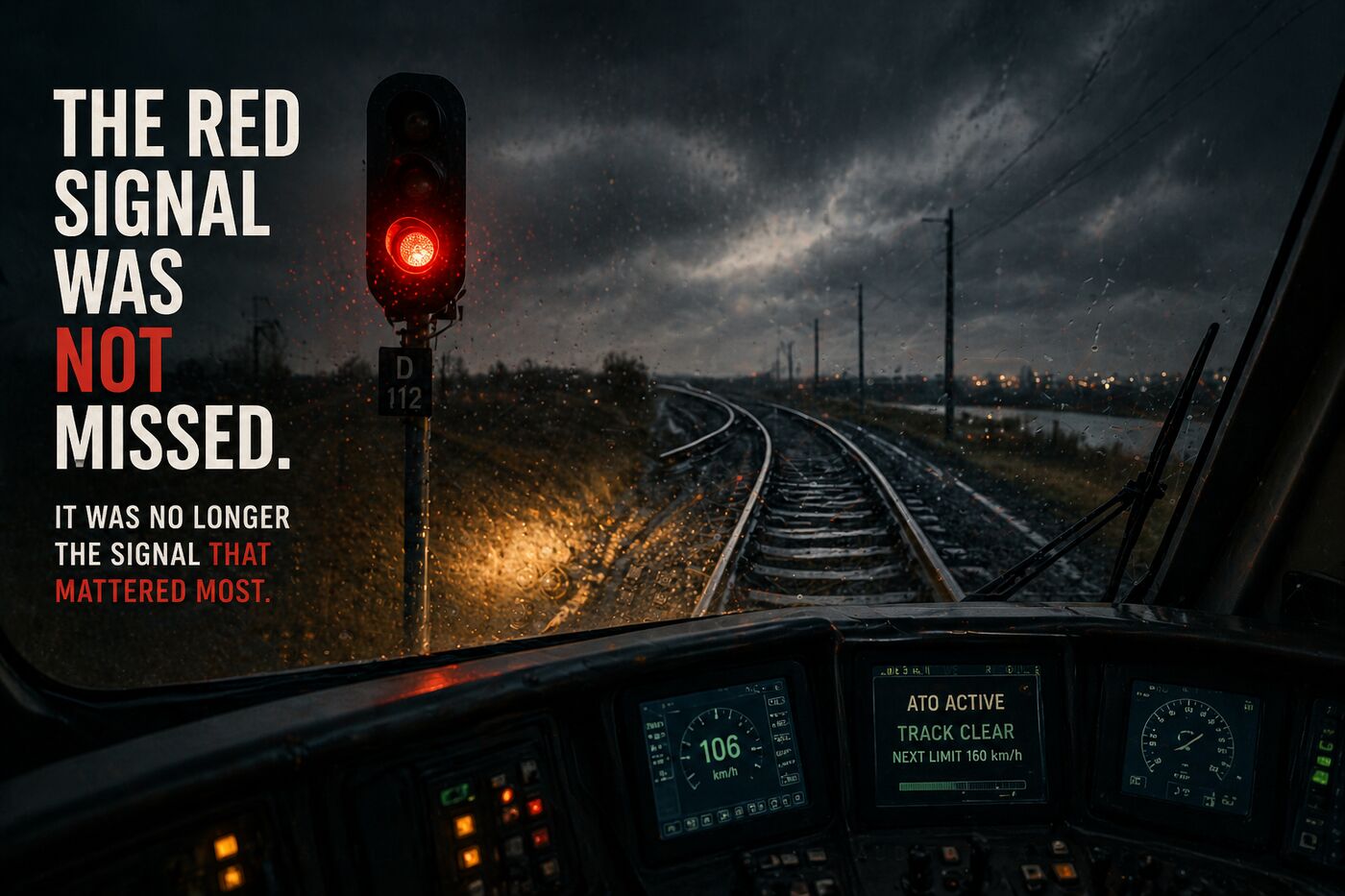
This is not a hypothetical. This is happening now. An investigation will examine procedures, signals, systems, and human error — whether the signal was visible, whether onboard systems behaved as expected, whether protocols were followed, whether the driver reacted in time. Those questions matter. But they don't, by themselves, reach the deeper failure. The signal existed. The system existed. The driver existed. And yet the train did not stop.
Inside the train, another system was present. It monitored, guided, warned, or failed to warn. In a system-mediated environment, the human doesn't only look at the world. The human also looks through the system that claims to interpret the world. That changes the hierarchy of attention: the external signal becomes one input among others, and the internal system becomes the frame through which the situation is understood. When the system doesn't alarm, the absence of alarm can become a signal stronger than the red light itself — not because it's more real, but because it's been granted authority.
The Failure Is Relational
This isn't an argument against railway automation, safety systems, or technical infrastructure, and it isn't an accusation against an individual driver before an investigation has been completed. It's a structural observation. Modern systems increasingly mediate decisions — they don't merely provide tools, they shape perception, priority, confidence, and action. When that happens, responsibility can detach.
Reasoning Displaced, Not Replaced
We often describe these failures as overreliance on technology. That phrase is understandable, but too weak. The deeper problem isn't reliance. It's displacement — the system doesn't fully replace human reasoning, it displaces it. The human role shifts: from reasoning to confirmation, from interpreting reality to checking system output, from questioning to assuming.
The Inversion of Signals
In ordinary perception, external reality has primacy. In system-mediated environments, internal outputs can begin to outrank external signals — the system's silence becomes reassurance, its absence of warning becomes permission. When a system becomes the primary source of truth, humans stop reconciling reality at the same depth.
This Is Not Only About Trains
The same pattern appears in cockpits, in hospitals, in administration, in AI-assisted work. Systems influence action while responsibility remains assigned to humans.
The Continuity of Responsibility
Responsibility isn't only assigned after failure. It's a live chain: intention → perception → reasoning → action → consequence. When systems enter that chain, they have to preserve reasoning continuity.
What Must Change
The answer isn't to remove systems. The answer is to design systems where reasoning stays visible, traceable, and continuous. We built infrastructure for movement — roads, signals, and rules that coordinate millions of agents in shared space. We never built equivalent infrastructure for reasoning. When systems participate in decisions, reasoning is no longer local. It has to become shared, inspectable, and continuous.
The red signal was not missed. It was no longer the signal that mattered most.
— Arne MayohDeclaration of Generative AI and AI-Assisted Technologies
This essay was developed with the assistance of AI systems as a research and editorial tool, for drafting support and structural revision. The argument and conclusions are the author's own.