The Infrastructure of Reasoning
We built infrastructure for movement. We never built equivalent infrastructure for reasoning.
Signals coordinate priority.
Rules coordinate behavior.
Logs coordinate accountability.
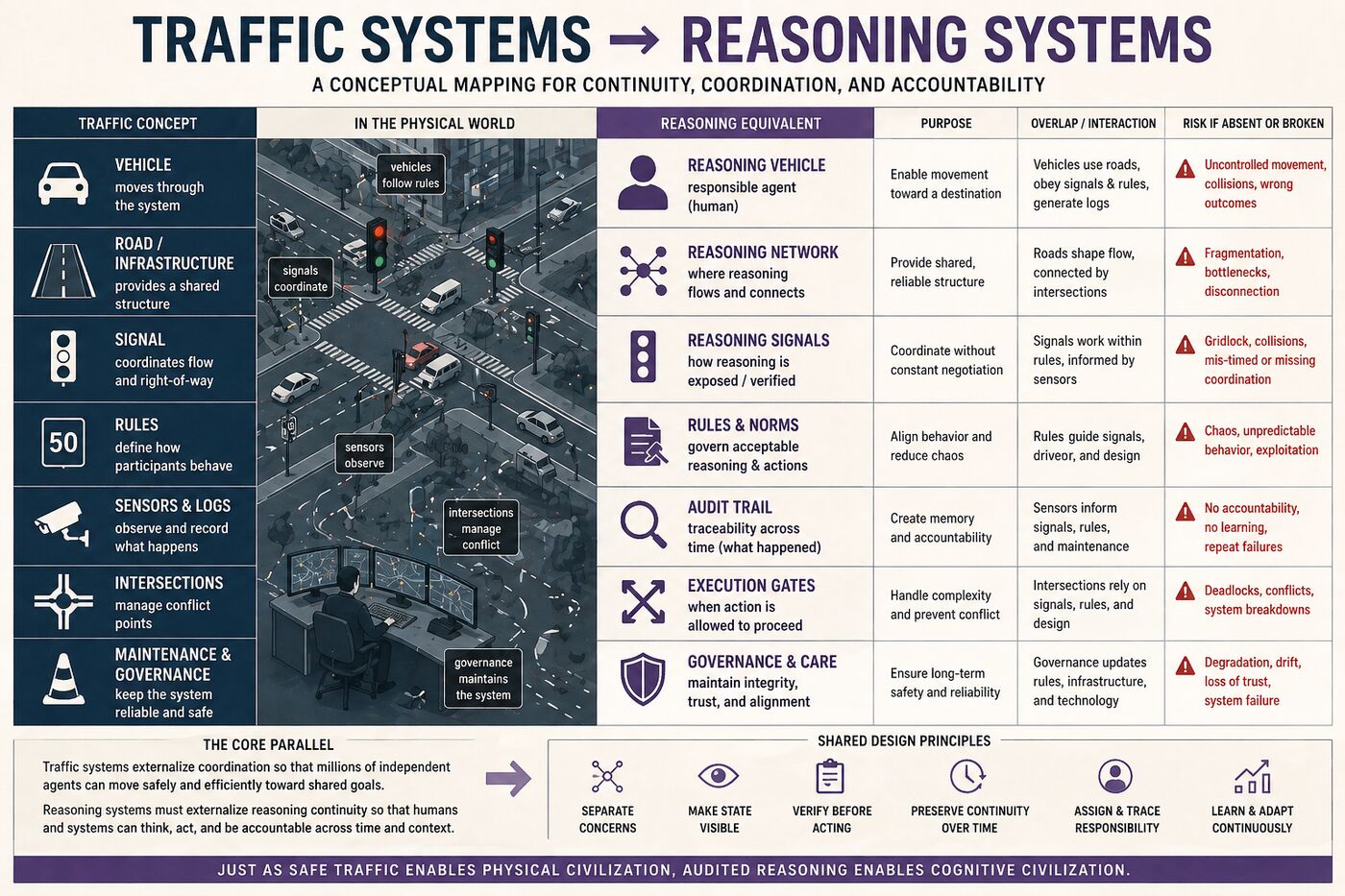
Modern civilisation depends on the fact that movement isn't left to individual negotiation. We don't expect every driver to invent rules at every intersection — we externalise coordination into infrastructure. Roads, lanes, signals, rules, inspections, maintenance, accident reports, and telemetry make movement possible at scale. Without them, vehicles don't become a transportation system. They become a collision field.
The Faster Engine Fallacy
Much of the current AI conversation focuses on capability — larger models, faster agents, more tools, more autonomy. This is the faster engine fallacy. An engine is not a system. A thousand high-speed engines placed into a field don't create mobility. They create danger, unless there's structure around them. The same is now true for reasoning. AI systems are no longer merely producing outputs — they're beginning to participate in action: searching, deciding, drafting, routing, executing, escalating, modifying, reporting. But the reasoning that guides those actions is still treated as temporary, local, and reconstructable after the fact. That assumption no longer holds.
Reasoning Is No Longer Local
Human reasoning was traditionally assumed to be internal — it lived in a person, a team, a document, a procedure, an institution. It could be discussed, challenged, revised, remembered. That model breaks when reasoning is distributed across humans, AI systems, tools, memory stores, APIs, workflows, dashboards, and automated decisions. In such environments, reasoning doesn't simply happen inside a mind. It moves — crossing boundaries, getting summarized, transformed, invoked, delegated, reused, acted upon. If that movement isn't structured, the reasoning fragments. And when reasoning fragments, responsibility, understanding, and human agency all become harder to preserve.
Traffic Systems for Reasoning
Traffic systems work because they separate concerns: vehicles move through the system, roads provide shared structure, signals coordinate priority, rules define acceptable behavior, logs and investigations preserve accountability. Reasoning systems need the same separation — reasoning vehicles that identify the responsible agents carrying intent, reasoning artifacts that preserve structured reasoning across time, reasoning networks that provide shared paths where reasoning can flow and connect, reasoning signals that expose whether reasoning has been verified or challenged, execution gates that determine when action is justified, and audit trails that preserve what happened, why, and who remains responsible. These are not metaphors only. They're design requirements.
From Output to State
Current AI systems are largely evaluated by output — was the answer useful, was the task completed, was the result persuasive. But output isn't enough once systems act. Action requires state: not just what was produced, but what reasoning was used, what assumptions were active, what alternatives were rejected, what authority was delegated, and what conditions justified proceeding. Without that state, success can become indistinguishable from appearance — the system reports completion, the interface signals confidence, the workflow proceeds, and the reasoning behind it may already be disconnected from reality.
Execution Gates
A traffic light is not merely decoration. It's a governance mechanism embedded into movement, determining when action may proceed. Reasoning systems need equivalent gates — before a system acts, escalates, sends, modifies, approves, or executes, there has to be a visible reasoning condition: what intention is being served, what reasoning justifies the action, what uncertainty remains, who owns the decision, what would invalidate proceeding. Without execution gates, action becomes faster than accountability.
Audit Trails Are Not Bureaucracy
Auditing is often misunderstood as after-the-fact compliance. In reasoning systems, audit trails are memory — they preserve the continuity required to understand how a decision was made, and let later actors continue reasoning rather than reconstruct it, making responsibility traceable across time. Without them, every handoff becomes interpretation, every interpretation becomes drift, every drift increases reconstruction cost. At scale, systems stop accumulating understanding. They accumulate outputs that have to be reinterpreted.
From Shadow AI to Audited State
Without shared reasoning infrastructure, we remain vulnerable to Shadow AI: systems that appear useful while their reasoning can't be traced, inspected, or continued. Shadow AI isn't merely hidden usage. It's hidden structure — decisions shaped by systems whose reasoning never enters the accountable record. The alternative is an audited state: a condition where reasoning is visible enough to be verified, durable enough to be continued, and structured enough to support responsibility. This doesn't mean every thought must be exposed. It means actions requiring responsibility must preserve the reasoning conditions under which they became justified.
Cognitive Civilisation
Traffic infrastructure enabled physical civilisation to scale — it let independent agents move through shared space without constant negotiation or collapse. Reasoning infrastructure is the equivalent requirement for cognitive civilisation: it lets humans and systems think, decide, act, and remain accountable across time and context. The goal isn't to slow reasoning down. It's to make reasoning durable enough that speed doesn't destroy continuity.
Safe traffic enables physical civilisation. Audited reasoning enables cognitive civilisation.
— Arne MayohDeclaration of Generative AI and AI-Assisted Technologies
This essay was developed with the assistance of AI systems as a research and editorial tool, for drafting support and structural revision. The argument and conclusions are the author's own.