Understanding Understanding
Why human understanding is fundamentally collective
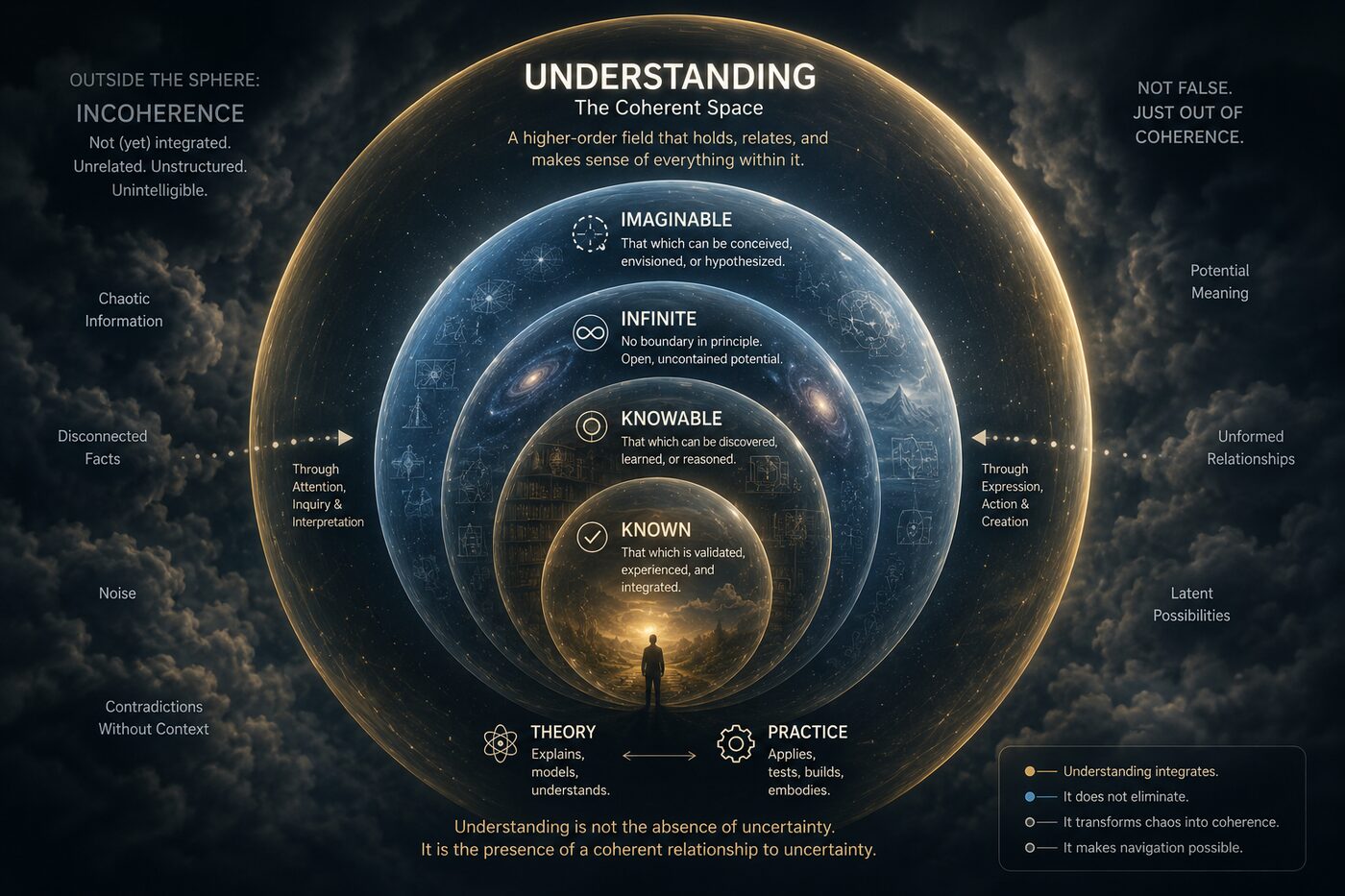
There's a quiet misconception embedded deeply in modern culture: that understanding is primarily individual. We speak about intelligence, expertise, reasoning, innovation, and knowledge as if they originate inside isolated minds. But the deeper one examines human understanding, the harder this becomes to defend. No human being independently created language, mathematics, science, philosophy, engineering, law, ethics, or civilisation itself. Every act of understanding emerges inside inherited continuity — we don't begin from nothing. We inherit symbols, interpretations, frameworks, assumptions, methods, stories, discoveries, failures, and partially stabilized coherence carried forward by others across time.
This realisation is genuinely humbling, because it means understanding is not merely individual cognition. It is collective continuity.
Inherited Coherence, Relational Meaning
A child doesn't invent language. A scientist doesn't rediscover mathematics from first principles. An engineer doesn't independently derive centuries of physical understanding before building a bridge. Human understanding is possible because civilisation preserves continuity across generations — and that continuity isn't merely information storage. This is territory Data as Representation of Truth and Coherence of Understanding already cover in depth: data isn't understanding, and understanding is relational rather than a possession of discrete facts. A concept only becomes meaningful through its relationship to other concepts, prior assumptions, lived experience, shared language, and coherent interpretation — which is why a student can memorise formulas while lacking understanding, an organisation can store documents while losing continuity, and an AI system can retrieve information while remaining unable to reconstruct why any of it matters.
Shared Understanding Is Never Perfect
An important consequence follows directly from this: shared understanding is always partial. No two humans carry identical interpretations. No system perfectly preserves meaning. No civilisation eliminates ambiguity. Human understanding has always depended on approximation, negotiation, revision, reinterpretation, and evolving coherence — and this isn't failure. It's the natural condition of finite cognition operating inside a genuinely complex reality. The goal was never perfect certainty. It's sufficiently coherent continuity for understanding to remain navigable.
Understanding Is Participatory
One of the deepest misconceptions of modern thought is that humans stand outside understanding as objective observers. But humans are participants inside evolving interpretive systems — we don't merely observe meaning, we inherit it, shape it, reinterpret it, and carry it forward. Understanding, seen this way, becomes participatory continuity. This explains why language evolves, science revises itself, philosophies transform, institutions drift, and cultures renegotiate meaning over time. Understanding stays alive because coherence itself is continuously maintained, challenged, repaired, and extended by the people participating in it.
AI Changes the Continuity Problem
For most of human history, continuity of understanding was carried primarily through humans, institutions, books, teaching, apprenticeship, and social structures. AI changes the scale and speed of this dramatically — reasoning now increasingly flows through probabilistic systems, distributed interfaces, machine-generated outputs, and rapidly evolving digital environments. That creates a new civilisational question, and it isn't simply "can AI generate useful outputs." It's whether continuity of understanding can survive accelerating distributed cognition. Without continuity, systems increasingly force humans into reconstruction rather than accumulation — and once reconstruction dominates, civilisation starts spending more effort rebuilding fragmented understanding than generating durable progress.
Understanding Understanding
Perhaps the most important realisation is this: understanding itself may be a higher-order coherence structure. Not isolated knowledge, not binary truth, not accumulated facts, but the condition under which relationships between things remain intelligible. This explains why understanding often feels larger than certainty — a person can deeply understand a domain while still carrying ambiguity, acknowledging uncertainty, revising assumptions, and remaining open to reinterpretation. Understanding is therefore not the absence of uncertainty. It's the presence of coherent orientation within uncertainty.
Civilisation may ultimately depend less on preserving information than on preserving reconstructable interpretation across generations — which reframes many modern challenges at once: AI governance, institutional trust, education, coordination, public discourse, and human agency itself. Beneath all of them sits the same deeper question: can coherent understanding continue accumulating faster than fragmentation forces reconstruction? That may become one of the defining infrastructure questions of the coming century.
The Quiet Realisation
No human being understands alone. Every act of understanding depends on inherited continuity, preserved interpretation, shared symbols, collective reasoning, and civilisational memory carried forward by others. We don't merely inherit knowledge from civilisation. We inherit partially stabilised coherence. And perhaps the future challenge isn't merely building more intelligent systems. It's learning how to preserve, share, and extend continuity of understanding itself — without losing the human capacity to participate meaningfully inside it.
No human being understands alone.
— Arne MayohDeclaration of Generative AI and AI-Assisted Technologies
This essay was developed with the assistance of AI systems as a research and editorial tool, for drafting support and structural revision. The argument and conclusions are the author's own.