Learning & Understanding
Living Vicariously
We have become very good at experiencing things we haven't lived — and far less capable of carrying that experience forward as understanding
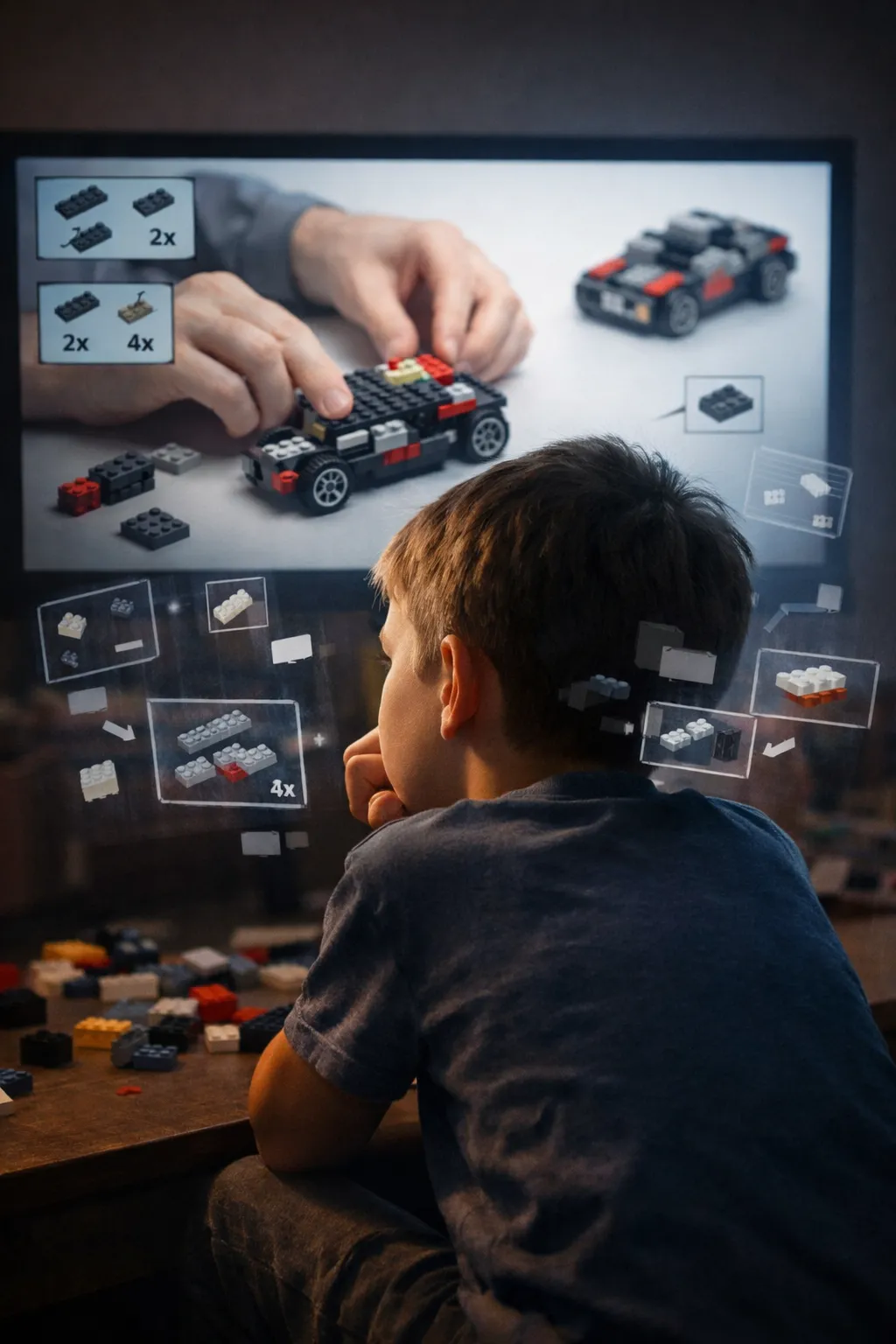
The Familiar Experience
A child watches a set of LEGO instructions on a screen. Step by step, pieces are assembled, the structure becomes visible, the logic of the build is there — but only as it unfolds. The child tries to follow, tries to remember, tries to reconstruct. What actually gets retained is fragments: this piece goes here, that connects there, something like this was done before. What's missing is the full reasoning that would make the structure continuable on its own. This isn't a failure of attention. It's a structural condition.
Vicarious Continuity
In that moment, something specific happens: the child experiences a form of vicarious continuity — following a reasoning process that appears coherent, connected, and complete. For a brief moment, understanding feels present. But it isn't yet owned. Once the sequence ends, the reasoning doesn't remain available in a form that can be continued without reconstructing it from scratch.
From Experience to Reconstruction
This pattern reaches far beyond a child and a screen. Across modern systems, we increasingly rely on video explanations, summaries, AI-generated answers, constant exposure to other people's conclusions — and we can follow reasoning more easily now than at any point before. But following was never the same thing as carrying forward. What's left after the experience is usually recognition without structure, familiarity without continuity, confidence without any of the reasoning actually retained. So we reconstruct. Again and again, every time.
The Hidden Cost
Reconstruction isn't neutral. Every time reasoning gets rebuilt, details get lost, assumptions shift, and meaning gets approximated rather than recovered exactly. Over time this produces interpretive entropy — understanding drifting even while effort stays high. Systems can look productive the entire time this is happening. Progress just becomes unreliable underneath it.
Continuity as Leverage
There's a different condition available. When reasoning can actually be carried forward without reconstruction, understanding stops resetting and starts accumulating — one thought leading to the next, structures extending, meaning staying intact across time. That's continuity, and it changes what progress actually looks like: less rework, less reinterpretation, more reliable outcomes. Not more output. More dependable accumulation.
From Exposure to Continuation
Vicarious experience isn't the problem here — it's often the entry point to real understanding in the first place. But without structures that preserve the reasoning behind it, it stays incomplete. The transition that actually matters is moving from experiencing understanding to continuing it.
If understanding can't be carried forward, learning repeats instead of accumulating, decisions have to be re-derived instead of extended, and governance turns interpretive rather than grounded. Systems gradually lose the ability to build on what they already knew — not because they stopped producing, but because they kept starting over.
Understanding is not the experience of clarity. It is the ability to continue it.
— Arne Mayoh
Declaration of Generative AI and AI-Assisted Technologies
This essay was developed with the assistance of AI systems as a research and editorial tool, for drafting support and structural revision. The argument and conclusions are the author's own.
Related
Part of the Audited State Research essays.