Learning & Understanding
Education After Generative AI
From text evaluation to reasoning traceability
For centuries, written assignments have functioned as one of the central mechanisms for evaluating knowledge in education. Essays, reports, and written exams were treated as evidence of understanding: if a student could produce a coherent text, the reasoning behind that text was assumed to belong to them.
Generative AI changes that assumption. Systems that can produce a well-structured essay in seconds make it genuinely difficult to treat the finished text as proof of individual competence. But the deeper challenge isn't simply that AI can write text — it's that the reasoning process which produced the text is no longer visible at all.
The Structural Tension
Educational institutions evaluate more than knowledge — they evaluate judgment, reasoning, and intellectual development. When AI participates in producing written work without leaving any trace of its role, the connection between the text and the student's own reasoning becomes genuinely hard to reconstruct. That's a real structural tension: AI accelerates knowledge production, while assessment systems depend on reasoning actually staying visible. When reasoning disappears behind generated text, evaluation itself becomes uncertain.
This is a real instance of approaching a continuity threshold. Educational systems have always relied on being able to reconstruct how understanding formed from the artifacts students actually produced. As reasoning becomes less visible and more distributed across AI-assisted process, that reconstruction gets harder and more costly — and past a certain point, evaluation can no longer reliably recover the reasoning behind a result at all.
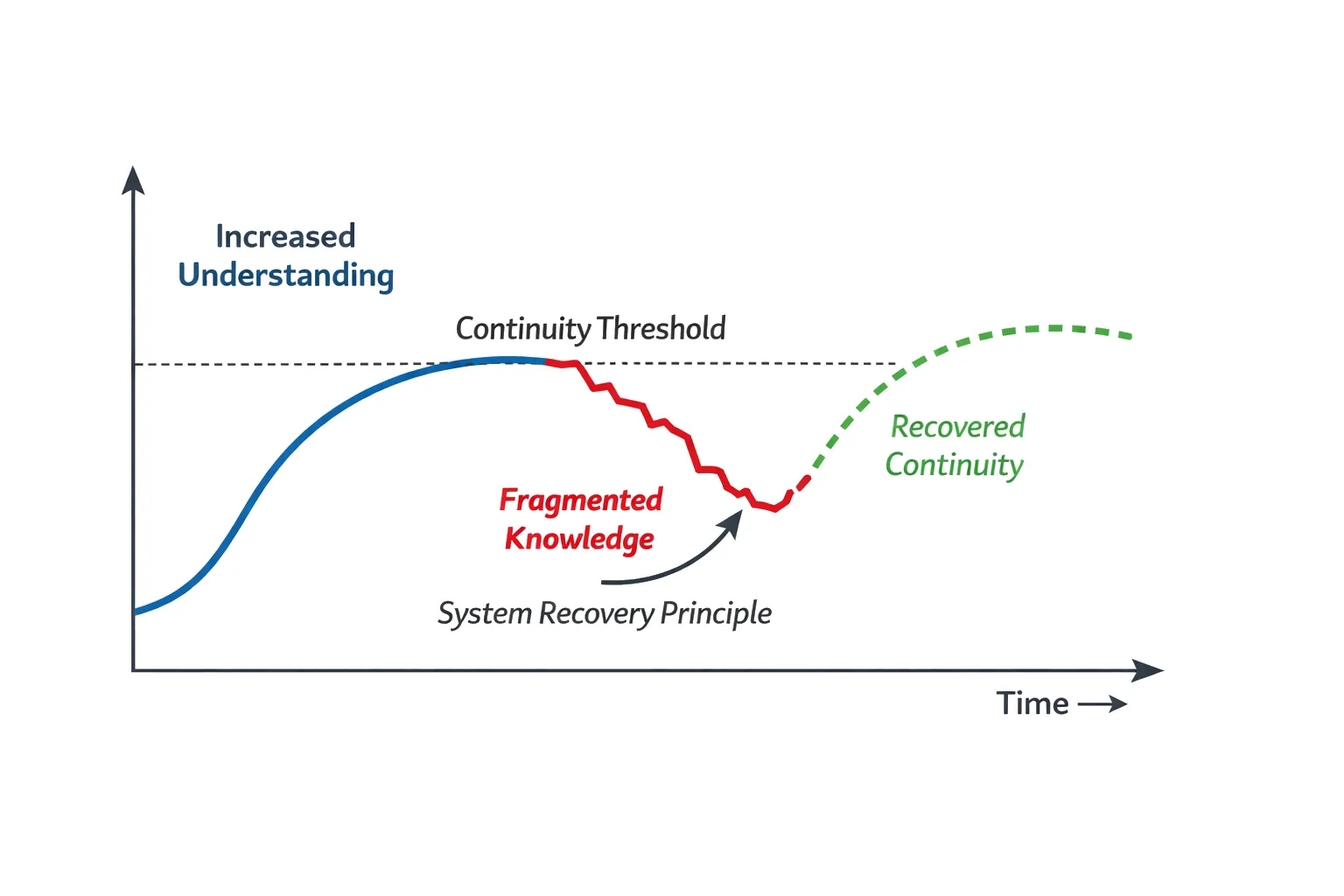
Preserving the Reasoning Path
One experimental response is to preserve the reasoning path itself, rather than only its finished output. This research programme records reasoning as a structured artifact called a Pay-It-Forward Record (PIFR) — not a replacement for narrative work like an essay, but a record of the reasoning path that actually produced it:
1. Intent
2. Exploration
3. Q&A
4. Analysis
5. Verification / Provenance
6. Lessons Learned
7. Conclusions
8. Revision / Critique
9. Save / Close / Revisit
Evaluating Reasoning Instead of Text
In an educational context, students could submit both the final essay and a structured reasoning record showing how the work actually developed — the questions explored, the interpretations weighed, and the specific role AI tools played in shaping it.
A Shift in What Gets Evaluated
Seen this way, generative AI doesn't just threaten existing assessment practice. It surfaces a deeper question that was always there underneath it: should institutions primarily evaluate the product, or the reasoning that produced it? This research programme explores whether structured reasoning artifacts can preserve continuity of thought in an environment where AI is accelerating intellectual work faster than most evaluation methods were built to track.
Whether this particular approach proves useful remains a genuinely open research question. What's already clear is that institutions will increasingly need some mechanism capable of preserving the traceability of reasoning — whatever form that mechanism ultimately takes.
When reasoning disappears behind generated text, evaluating the text is no longer the same thing as evaluating the understanding.
— Arne Mayoh
Declaration of Generative AI and AI-Assisted Technologies
This essay was developed with the assistance of AI systems as a research and editorial tool, for drafting support and structural revision. The argument and conclusions are the author's own.
Part of the Audited State Research essays.