A Cybernetic Ecology for Human–AI Systems
Intent, Computation, Action, and Ethical Constraint
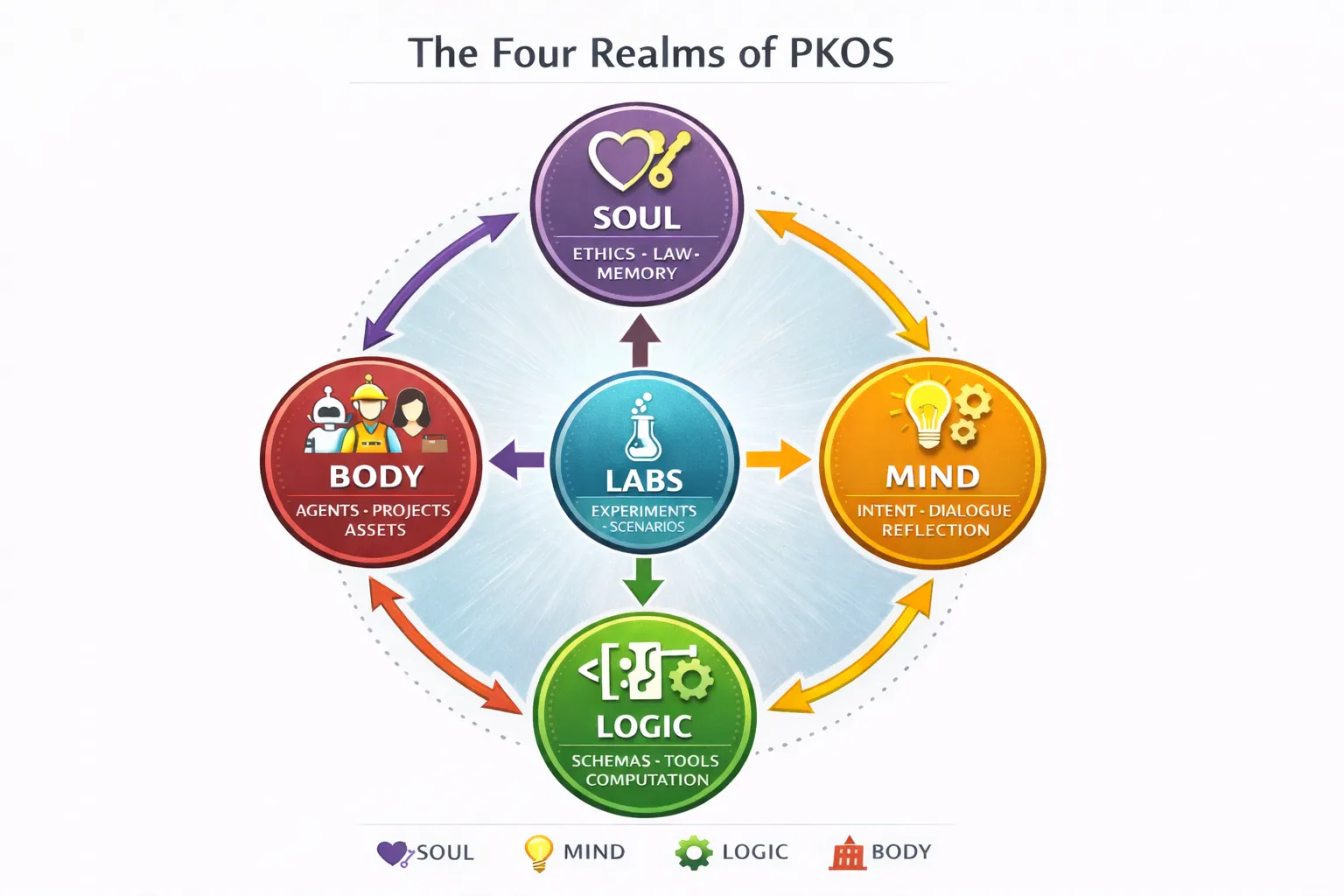
Collective reasoning does not occur in a single domain. It emerges from the interaction of intention, computation, action, and ethical constraint.
Human societies have long developed institutions that coordinate these domains: law establishes normative boundaries, dialogue shapes interpretation, tools enable analysis, and organizations translate decisions into action.
Together these elements form a distributed reasoning system through which societies think, decide, and act.
Four Realms of Collective Reasoning
SOUL   → ethics · law · memory
MIND   → intent · dialogue · reflection
LOGIC  → schemas · tools · computation
BODY   → agents · projects · assets
Each realm represents a distinct function within the reasoning system.
Labs allow systems to generate variety without immediately committing to irreversible action.
In cybernetic terms this relates to requisite variety.
Reasoning as a Trajectory
intent → interpretation → analysis → decision → action
When these trajectories disappear, later observers see only resulting events.
The reasoning that produced them must be reconstructed.