Systems Perspective
Why the whole thing holds together, with no one in charge of it
A system can look convincing long before it truly works. Its faults appear in flow, friction, delay, and failure — measurable effects that drive adaptation.
The Systems Question
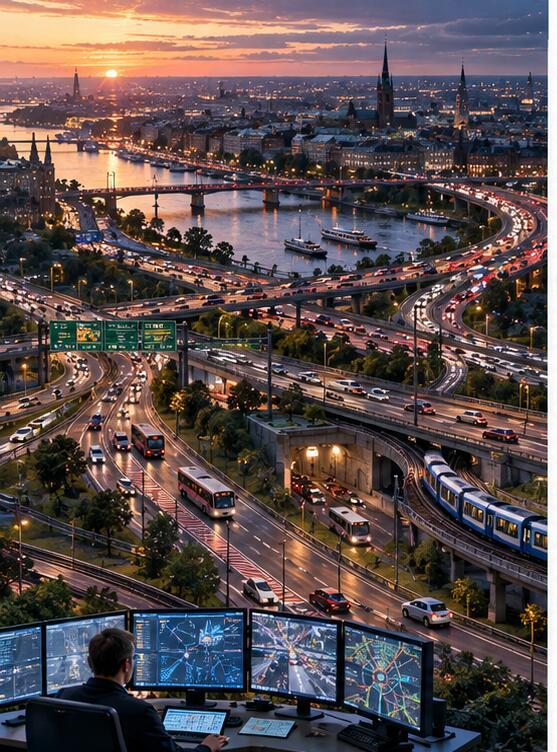
Look down on any real interchange at rush hour and the honest question isn't "who is in charge of this." Nobody is. Thousands of drivers, buses, trains, cyclists, and pedestrians move through the same shared space, each making their own decisions, and the whole thing mostly works anyway.
The systems question is simply: how? How can this many independent actors remain sufficiently coordinated without one intelligence directing every movement — and what does it take for that coordination to survive an accident, a closed lane, or a sudden surge nobody planned for?
PKOS asks the same question about reasoning instead of traffic.
Traffic Vocabulary, Systems Vocabulary
| In traffic | Systems Perspective |
|---|---|
| Changing traffic conditions | Environment |
| Cars, buses, trains, pedestrians | Agents |
| Traffic lights | Signals |
| Cameras, detectors | Sensors |
| Queues, accidents, delays | Feedback |
| Diversions, changed timing | Adaptation |
| Different vehicle capabilities | Variety |
| Rules, signals, infrastructure together | Regulation |
| Emergency vehicle priority | Handling exceptional states |
| Traffic control centre | Governance / system observation |
The Feedback Loop
A functioning system has to perceive enough of what is happening to regulate what is happening. That single sentence is most of what W. Ross Ashby's cybernetics was ever really about, and it holds together the same way in a traffic network or a reasoning network:
                ENVIRONMENT
     traffic volume · weather · incidents
                    │
                    ▼
                 SENSORS
                    │
                    ▼
     ┌──────────  REGULATION  ──────────┐
     │                                  │
     ▼                                  │
   SIGNALS ─────────► AGENTS ───────────┘
     │                   │
     │                   ▼
     │             SYSTEM EFFECTS
     │           flow · delay · conflict
     │                   │
     └────────  FEEDBACK ◄┘
                    │
                    ▼
          GOVERNANCE / MAINTENANCE
Notice what this diagram does not contain: a single box labeled "controller" that everything answers to. Regulation emerges from the loop itself — sensors feeding signals, signals shaping agents, agents producing effects, effects feeding back into sensors again. Remove any one piece and the loop doesn't get smaller. It stops being a loop.
Requisite Variety
There's a precise reason a fixed, one-size-fits-all signal timing eventually fails no matter how well it's tuned: the system trying to regulate traffic has to have at least as much variety in its own responses as the traffic itself throws at it. A signal that can only ever do "red, then green, on a timer" cannot regulate a network that sometimes has an ambulance, sometimes has a parade, and sometimes has black ice. This is Ashby's Law of Requisite Variety, and it's the same reason PKOS treats reasoning-handling capacity as something that has to match the actual variety of situations reasoning encounters, not the variety someone assumed in advance.
Everything on this page is the theory. Process Perspective is what it looks like at street level, at the moment something is actually allowed to move.