Learning Beyond the Continuity Threshold
Learning is not guaranteed to accumulate. It accumulates only under conditions where understanding can be carried forward.
For most of modern history, we have assumed that learning is inherently cumulative. Knowledge builds. Science progresses. Understanding deepens over time.
Even when disrupted — by loss, crisis, or paradigm shifts — systems have eventually recovered. Writing preserved memory. Institutions preserved knowledge. Disciplines preserved methods.
This assumption is so deeply embedded that it is rarely questioned:
that learning, however imperfect, moves forward.
The Hidden Condition
What this assumption overlooks is that cumulative learning has always depended on a structural condition:
continuity of reasoning
Not just access to prior outputs. Not just storage of results. But the ability to carry forward:
- why something was understood
- how a conclusion was reached
- what assumptions were involved
Without this continuity, learning does not accumulate.
It reconstructs.
Reconstruction as a Substitute for Continuity
In the absence of preserved reasoning, systems compensate through reconstruction:
- reinterpreting past results
- inferring intent from incomplete traces
- rebuilding context from fragments
This works — up to a point.
Reconstruction allows systems to appear cumulative even when continuity is weak. But reconstruction is costly, approximate, and time-bound.
The Continuity Threshold
There exists a continuity threshold where this balance shifts.
At that point, the cost of reconstruction exceeds the system’s ability to carry understanding forward.
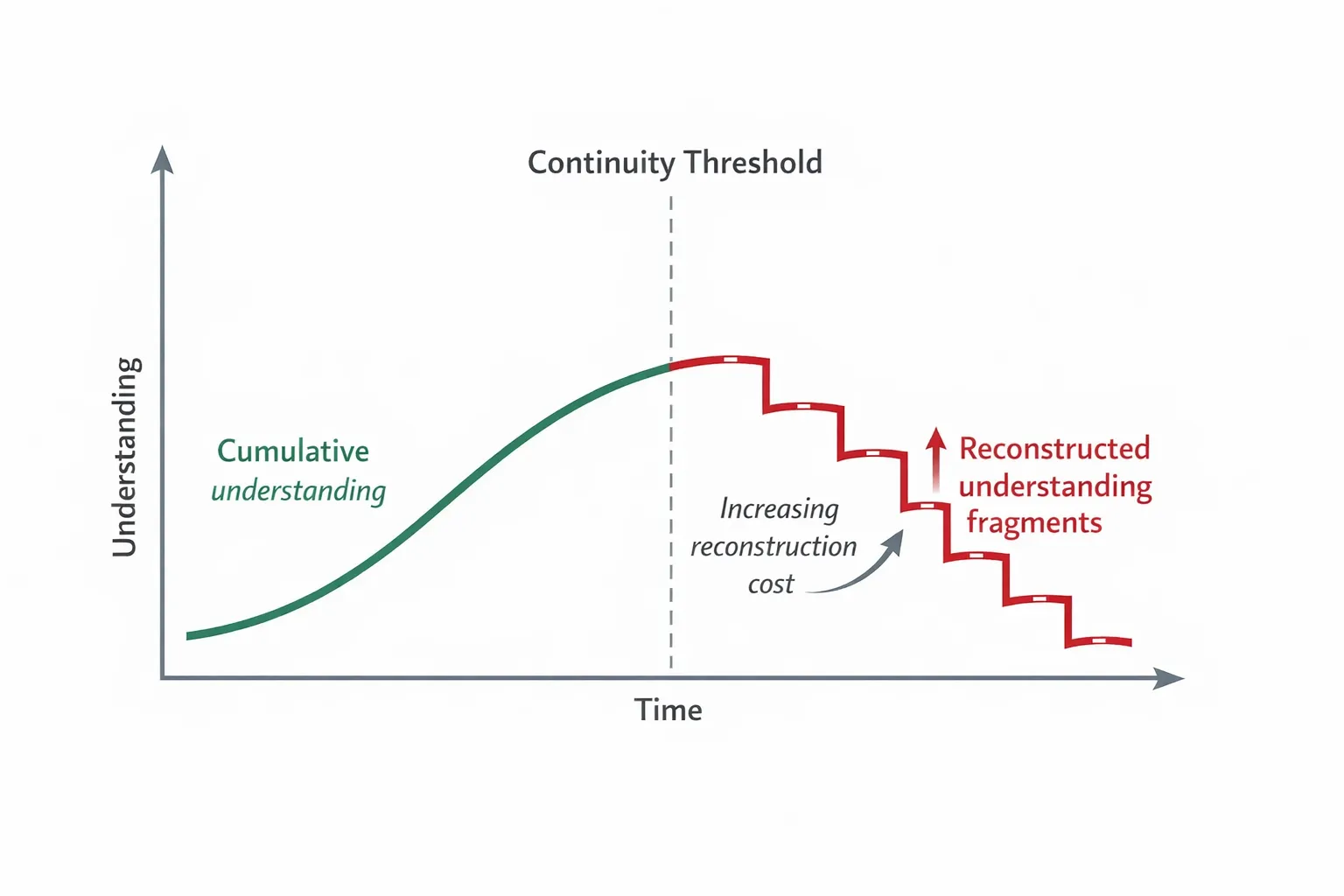
Below the threshold, understanding accumulates. Beyond it, reconstruction replaces continuity.
At this threshold:
- reasoning fragments faster than it can be reassembled
- context decays faster than it can be restored
- decisions lose their lineage
What Happens Next
Beyond this threshold, learning does not simply slow down.
It changes behavior.
Phase 1 — Fragmentation
Understanding becomes unstable. Repeated rework becomes normal. Systems produce more outputs, but less of what they produce can be reliably carried forward.
Phase 2 — Stagnation
Effort shifts from advancing knowledge to maintaining local coherence. More and more work is spent reconstructing context rather than extending understanding.
Phase 3 — Regression
The system begins to lose previously held understanding.
Not because knowledge vanishes, but because it can no longer be maintained as a continuous structure.
Regression Without Realizing It
This form of regression is subtle.
- outputs may still increase
- activity may still accelerate
- stored material may still expand
But:
understanding no longer compounds
This creates a paradox:
a system that produces more knowledge, but retains less understanding.
Why This Matters Now
Historically, recovery mechanisms existed. Writing externalized memory. Institutions stabilized knowledge. Disciplines structured reasoning.
But these mechanisms depended on relatively stable rates of change.
Under accelerating systems — particularly AI-driven reasoning — the rate of generation begins to exceed:
- human interpretive capacity
- institutional integration capacity
- existing continuity mechanisms
The question is no longer:
Can we produce knowledge?
But:
Can we carry understanding forward fast enough?
The Missing Recovery Principle
If continuity breaks at scale, recovery cannot rely on more output, more retrieval, or more processing.
It requires a structural mechanism that preserves reasoning across contexts and time.
This is the role of a Persistent Semantic Scaffold: not merely to store artifacts, but to preserve the semantic continuity required for understanding to remain inspectable and extensible.
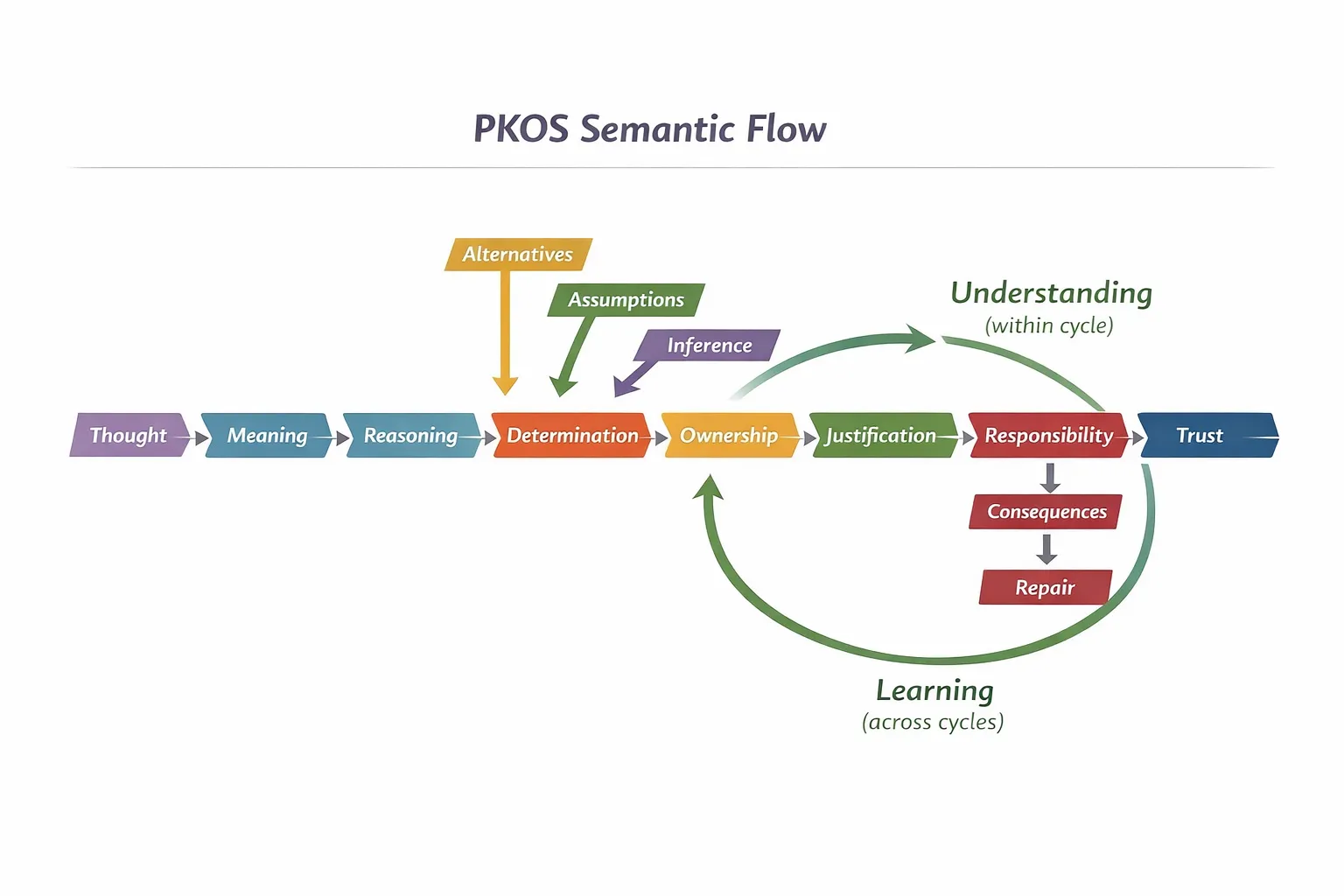
Understanding emerges within a cycle. Learning accumulates only when that cycle can be continued across time.
Without such a recovery principle:
- learning becomes cyclical
- effort becomes reconstructive
- progress becomes unstable
Not Inevitable — But Conditional
This decline is not inevitable.
History shows that new structures can restore continuity. But each recovery required a shift in how understanding was preserved.
We may now be approaching a point where existing structures are no longer sufficient.
Human Agency After the Threshold
When understanding can no longer be carried forward, the loss is not only epistemic.
It is also a loss of agency.
Humans may remain present in systems that retrieve, generate, and accelerate outputs. They may still approve, respond, select, and participate.
But if the reasoning shaping action can no longer be continuously inherited, inspected, and extended without reconstruction, human participation becomes increasingly shallow.
Under those conditions, what is lost is not merely retained knowledge, but the continuity required for people to remain real participants in the systems they inhabit.
Human agency is not preserved by presence alone.
It depends on the continuity of understanding that allows people to re-enter reasoning without starting over.
Final
Learning is not guaranteed to accumulate.
It accumulates only under conditions where understanding can be carried forward.
Beyond the continuity threshold, learning does not stall — it begins to regress.