← Return to the Cognitive Journey
Continuity of Understanding
How can human understanding remain continuous in a world of accelerating reasoning systems?
The Problem
Civilizations preserve artifacts — but rarely the reasoning that produced them. Without that reasoning, inheritance becomes blind.
What remains are conclusions without context:
- decisions without justification
- concepts without stable meaning
- policies detached from their original intent
This is not failure.
It is structural loss.
The River of Change
There is an old idea:
No man ever steps in the same river twice.
The world is always changing. Context shifts. Information evolves.
This has always been true.
But today, something else has changed:
The speed at which everything flows.
AI and digital systems do not create change — they accelerate it.
And with acceleration comes a new condition:
What cannot be carried forward is lost faster.
The Bridge of Continuity
Continuity is not a feature.
It is a structure.
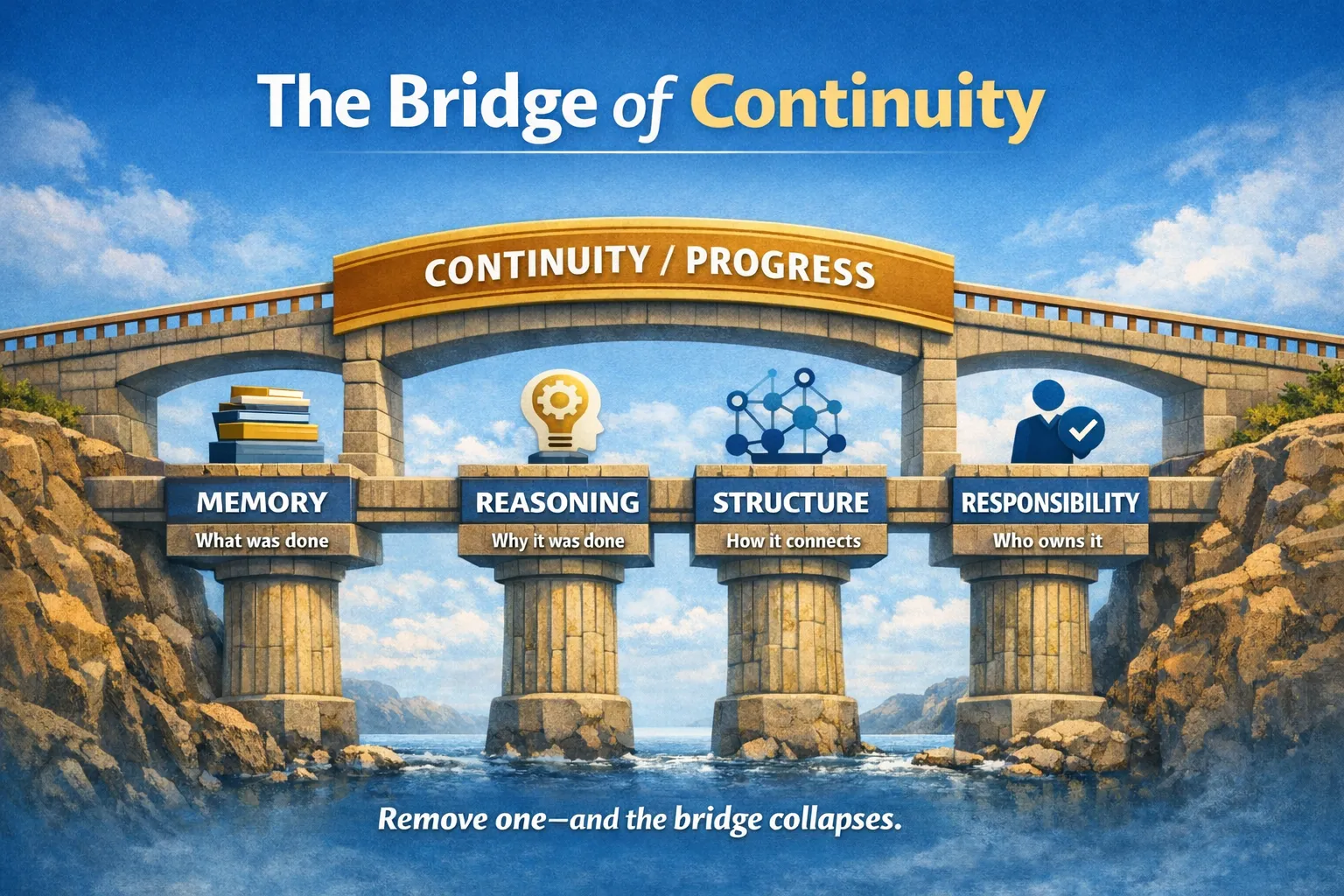
Continuity requires memory, reasoning, structure, and responsibility to remain intact. Remove one—and the bridge collapses.
Think of continuity as a bridge across the river of change.
- Memory — what was done
- Reasoning — why it was done
- Structure — how it connects
- Responsibility — who stands behind it
When the bridge holds:
- understanding carries forward
- decisions remain meaningful
- knowledge accumulates
When it breaks:
- we reconstruct instead of continue
- meaning drifts
- progress resets
The Hidden Cost
Most of this loss is invisible.
We call it:
- “revisiting”
- “realigning”
- “starting fresh”
But in reality:
We are reconstructing what we already understood.
Over time, this leads to:
- repeated effort
- cognitive fatigue
- fragmentation of meaning
This condition has a name:
What Continuity Enables
Continuity is not about preservation.
It is about accumulation.
- learning compounds
- reasoning evolves
- collaboration extends across time
- responsibility remains intact
Continuity turns effort into progress.
Or more simply:
Doing the same thing isn’t insanity—forgetting what happened last time is.
Why This Matters Now
We have built systems that:
- generate
- distribute
- optimize
But not systems that:
preserve understanding as something that can be continued.
Civilizations do not progress because they produce more.
They progress when what is understood can be carried forward.
“Civilizations accumulate knowledge only when reasoning becomes durable enough to continue.”
We don’t lose progress because we forget. We lose it because the bridge between what we did and what comes next doesn’t hold.